01
Is AI shaping the client's expectations before your lawyers can?
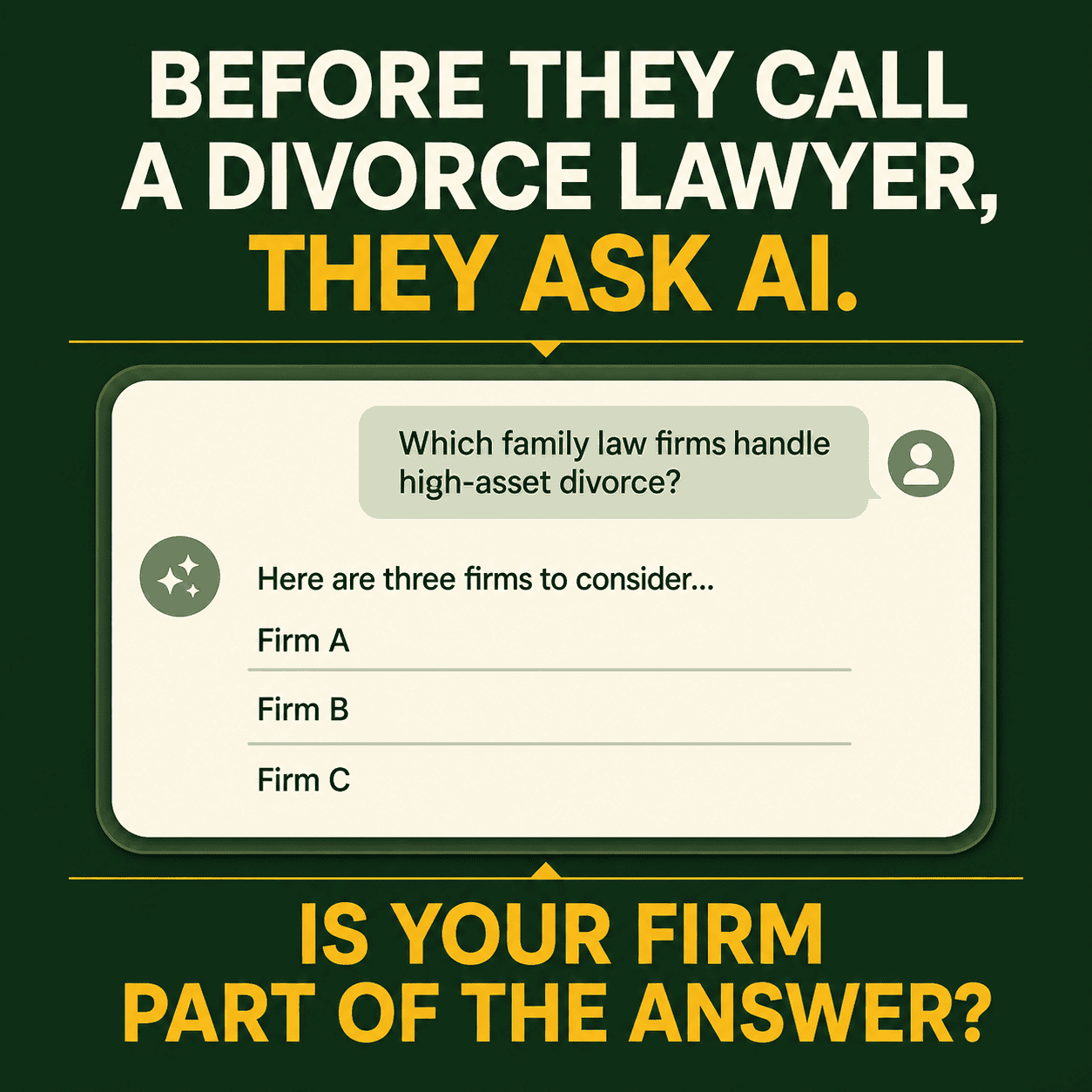
A person may ask AI whether to move out, how custody works or what happens to a business before deciding whether to call any firm.
A Precision Practices Executive White Paper
Prospective clients are privately asking AI about custody, money, the family home, mediation and what happens next. Increasingly, those conversations can move directly into which family law firm should I call?
Source: Clio, 2025 Legal Trends Report
No form. No gate. Direct access to the complete PDF.
The Questions Behind the Paper
AI visibility is not a technology side project. It affects whether your firm enters a prospective client's consideration set before the first consultation ever occurs.
A person may ask AI whether to move out, how custody works or what happens to a business before deciding whether to call any firm.
Listing divorce, custody and support does not demonstrate depth in high-asset matters, contested custody, complex property division, mediation or collaborative law.
Attorney authority, court experience, reviews, referrals and community reputation create value only when AI can connect that evidence to the client's specific need.
Your CRM cannot record an inquiry your firm never received. Rankings cannot tell you when AI omits, misrepresents or flattens your practice.
What the White Paper Examines
Family law has always involved a long period of private uncertainty before a client is ready to identify themselves. AI now fits naturally into that stage and can carry the conversation all the way to lawyer selection.
The issue is not whether Google disappears. It is whether a growing share of clients reaches Google, your website or your intake team only after an AI system has already helped define what they need and which firms appear credible.
A Five-Minute Leadership Test
Replace the bracketed language with your firm, market and priority matters. Use the exact same wording across multiple AI platforms. Do not look only for whether your name appears. Look at how accurately the system describes your attorneys, experience, geography and reasons a client might choose the firm.
Record the platform, model, date, exact prompt, location context, firms surfaced, sources cited and factual accuracy. AI responses change. Patterns matter more than a single favorable answer.
Protect What You Have Already Built
Read the complete white paper and determine whether your reputation, attorney authority and market position are translating into AI recommendation visibility.
Download the Family Law AI Visibility White PaperStraight Answers
No. SEO helps a firm earn visibility in search results. AI visibility concerns whether AI systems can accurately understand, validate, compare and include the firm in a synthesized answer or recommendation. Strong SEO can help, but it does not guarantee inclusion in an AI-generated shortlist.
People considering divorce may spend weeks or months privately asking questions about children, finances, housing and next steps before they are ready to contact an attorney. AI allows those questions to progress into lawyer discovery and comparison inside the same conversation.
Yes. Begin with the three prompts on this page and document the platform, model, date, exact wording, location context, firms named, sources cited and accuracy. Repeat the test over time because AI answers can vary and change.
Do not optimize around one answer. Evaluate patterns across platforms and priority matters, then examine entity clarity, attorney authority, service specificity, content structure, geographic relevance and third-party validation.
No. AI-generated information can be incomplete, inaccurate or inappropriate for a person's jurisdiction and circumstances. It is not a substitute for confidential legal advice from a qualified family law attorney. For law firms, the issue is understanding how AI may influence research and lawyer selection before a consultation occurs.
The Next Question
Precision Practices helps law firm leaders see how AI platforms interpret, compare and recommend their firms, then identifies the gaps between market reputation and digital visibility.
Request an AI Shortlist Review