

Law Firm Intake
Where Revenue Is Won or Quietly Given Away
Most firms believe growth stalls due to marketing.
It rarely does.
Growth doesn’t stall because demand disappears.
It stalls when intake breaks under pressure- when volume rises, urgency spikes, and partners are no longer personally involved.
If you’re spending five or six figures a month to generate demand but signed matters don’t scale, you’re not investing in growth.
You’re financing your competitors’ client acquisition.
The Reality Senior Partners Underestimate
The modern legal consumer is not comparison shopping.
They are under stress, out of time, and risk-averse.
They are not searching for the “best” firm.
They are searching for the first firm that creates certainty.
What actually decides the outcome:
- Speed
You are exponentially more likely to convert a lead contacted within five minutes than one contacted thirty minutes later. - Responsiveness
Nearly seven in ten legal consumers cite responsiveness—not reputation or results—as the primary reason they hire a firm.
First Contact Advantage
The majority of legal consumers retain the first firm that answers the phone and moves them forward.
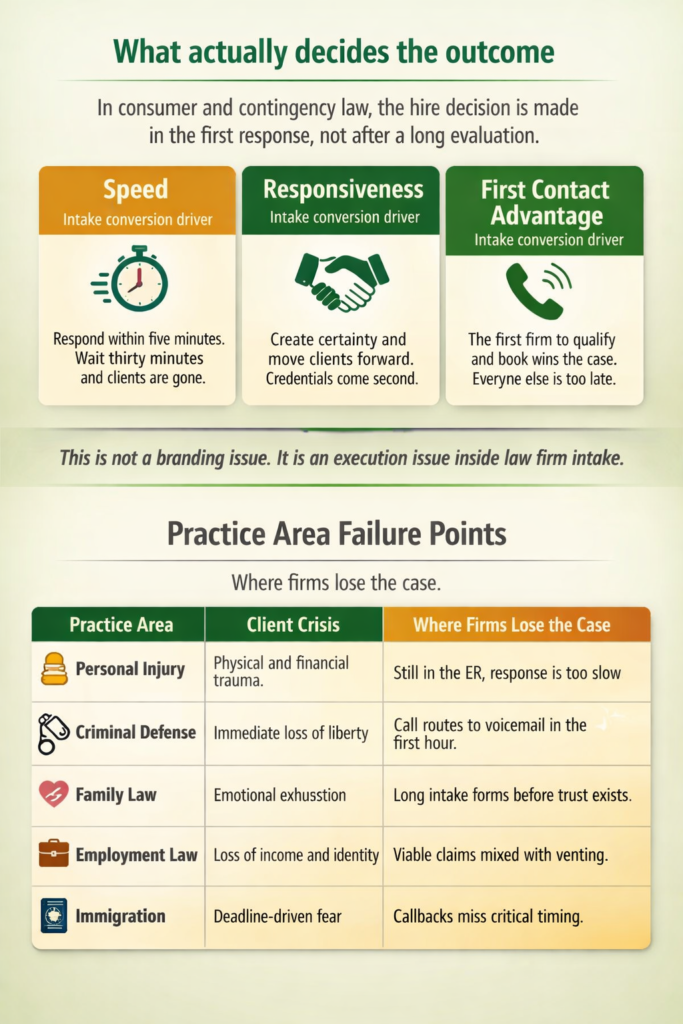
What actually decides the outcome
In consumer and contingency practices, the hire decision is usually made during the first response, not after a long evaluation.
Speed
Law firms that respond within five minutes convert dramatically more consultations than firms that respond thirty minutes later.
Responsiveness
Legal consumers hire the firm that creates certainty and moves them to a next step, even when a competitor has better credentials.
First Contact Advantage
The first firm to answer, qualify, and schedule wins the case intake. The rest get compared, delayed, or never contacted again.
Practice area failure points
Each practice area has a specific crisis context. When intake is slow or high friction, the case is lost before a lawyer speaks to the client.
| Practice Area | Client Crisis | Where firms lose the case |
|---|---|---|
|
Personal Injury
Practice Area
|
Client Crisis
Physical and financial trauma
|
Where firms lose the case
Slow response while the client is still in the ER or hospital bed
|
Criminal Defense |
Immediate loss of liberty | Calls are routed to voicemail or message takers during the first critical hour |
Family Law |
Emotional exhaustion | Long, invasive intake forms that feel punitive before trust exists |
Employment Law |
Loss of income and identity | No filtering between viable claims and emotional venting |
Immigration |
Deadline-driven fear | Delayed callbacks when timing is legally decisive |
Tactical Chaos vs. Operational Control
Most firms believe they have “good people” handling intake.
They often do.
But good people do not scale.
They compensate. They improvise. They remember details in their heads. They step in when something feels off.
That works until volume increases, urgency spikes, or the right person is not available.
Systems do not compensate.
They perform.
They define what happens next, enforce standards under pressure, and create consistency regardless of who is on duty. They make outcomes repeatable instead of heroic.
The difference is not effort.
It is design.
Firms stuck in tactical chaos look like this:
- Receptionists collect names and numbers\
- Follow-up happens “when someone is free”
- PDFs are emailed and hoped for
- Data is manually re-entered or lost
If your firm is busy but results feel uneven, this is where control gets rebuilt.
Firms built for scale operate differently:
- Intake specialists actively move prospects to next steps
- Response happens immediately, not eventually
- Retainers are signed digitally during the first interaction
- CRM data syncs automatically, in real time
Everything is systematized in a way that is truly scalable and does not require partner level intervention.
Law firm intake FAQ
These questions surface where intake breaks under pressure and what to measure to stop revenue leakage.
What is our average speed to lead for inbound inquiries?
Speed to lead is the time from first contact (call, form, chat, text) to a real response from your firm. If you cannot report this by channel, you are running intake on anecdotes.
- Track medians, not just averages.
- Separate business hours vs after-hours performance.
- Break out by channel: phone, web form, chat, text, referral.
How many target matters failed to sign last month, and why?
If the reasons are vague, intake is not measurable. You need standardized loss reasons tied to a stage in the process.
- Not contacted in time
- Could not reach after attempts
- Price or retainer friction
- Conflict or scope mismatch
- Chose competitor
- Unqualified claim
Can a client retain us from their phone in under one minute?
This is a friction test. If your intake flow requires printing, scanning, or desktop-only steps, you are losing high-intent prospects.
- Mobile-friendly engagement letter
- Text link to e-sign during the call
- Payment link or deposit option when appropriate
- Instant confirmation and next-step instructions
What happens after hours, on weekends, and when the partner is unavailable?
Intake performance is usually best when the “right person” is on duty and worst when coverage is thin. Your system is only as strong as its off-hours behavior.
- Is a live human answering, or is it voicemail?
- How fast do you respond to web forms after hours?
- Do you capture enough information to move the prospect forward immediately?
Do we have a written definition of a qualified lead for each practice area?
Without qualification standards, firms either waste attorney time on weak leads or miss strong leads due to inconsistent judgment.
- Eligibility and disqualifiers
- Urgency triggers
- Minimum fact set needed to schedule a consult
- Clear handoff rules to an attorney
How many contact attempts do we make, and over what time window?
Many firms fail because they stop too early. A consistent follow-up cadence is a system requirement, not a personality trait.
- Define attempts: call, text, email
- Define cadence: same day, 24 hours, 72 hours
- Log outcomes: reached, left message, no answer, wrong number
Do we measure conversion by stage, not just signed or not signed?
Stage metrics tell you where revenue leaks. Without them, you cannot isolate the problem.
- Inquiry to contacted
- Contacted to scheduled
- Scheduled to showed
- Showed to retained
Is our intake process consistent across phone, form, chat, and referral?
Prospects do not care which channel they used. If your firm treats channels differently, outcomes vary and revenue leaks.
- Same qualification criteria
- Same service-level expectations
- Same follow-up cadence
- Same retainer or next-step mechanics
What Is An Intake Diagnostic?
An Intake Diagnostic
starts with a concise assessment questionnaire that pinpoints structural weaknesses in how your firm captures, qualifies, and converts demand.
It reveals what is actually happening at first contact across calls, forms, and follow-up, not what leadership assumes is happening.
The diagnostic exposes where value is leaking through delay, inconsistency, or over-reliance on individual judgment.
You gain clear visibility into what’s costing you momentum, which failures matter most, and where intervention will have the greatest impact.
The result is a prioritized, practical path to restore control, improve conversion, and create a more predictable intake operation.
Intake Articles

The Intake Leak in Your Bucket: Why Your Best Leads are Hiring Your Competitors
Your firm is generating strong leads, yet many are quietly hiring another firm creating an intake leak. This article reveals where clarity, responsiveness, and trust break down and why high value prospects disengage before you realize you were being evaluated.

Law Firm Lead Loss? Why Your Firm Is Losing Clients Before They Ever Call You
Most professional services firms do not lose clients after a call. They lose them before contact ever happens. This article explains how unclear positioning and fragmented messaging quietly filter firms out of consideration, resulting in your Law Firm Lead Loss and what you can do to fix first.

The Intake Gap No Dashboard Ever Shows
Intake gap? Failures don’t show up on dashboards. Learn where qualified prospects are being lost and how a quick Intake Diagnostic reveals the gap.
How We Help - Wider Precision Practices Services
Strategic Repositioning & Growth Planning
Refresh your vision. Rebuild your foundation. Re-energize your team. We turn complexity into clarity, creating focus, alignment, and measurable results. Outcome: Create clarity that unlocks confident decision-making.
Revenue Alignment & Operational Optimization
Build systems that support growth without sacrificing sanity or soul. From CRM to RevOps to KPIs, we ensure your operations drive performance. Outcome: Build operations that scale without burnout.
Messaging, Brand & Market Presence
Your story should reflect who you are now, not who you were five years ago. We craft positioning and messaging that attract the right clients — and keep them. Outcome: Tell a story that attracts ideal clients and top talent.
