
Law Firm Positioning Strategy
Strong legal work does not automatically create strong market positioning. Law firm positioning is the discipline of making your expertise clear, relevant, credible, and easy to understand before a prospect ever calls.
When a firm’s message is too broad, too generic, or too inward-facing, the market fills in the blanks. Usually badly.
What this page covers
- What law firm positioning actually means
- Why expertise often gets lost in translation
- How weak positioning hurts visibility and conversion
- What strong positioning sounds and looks like
- How positioning connects to the broader growth system
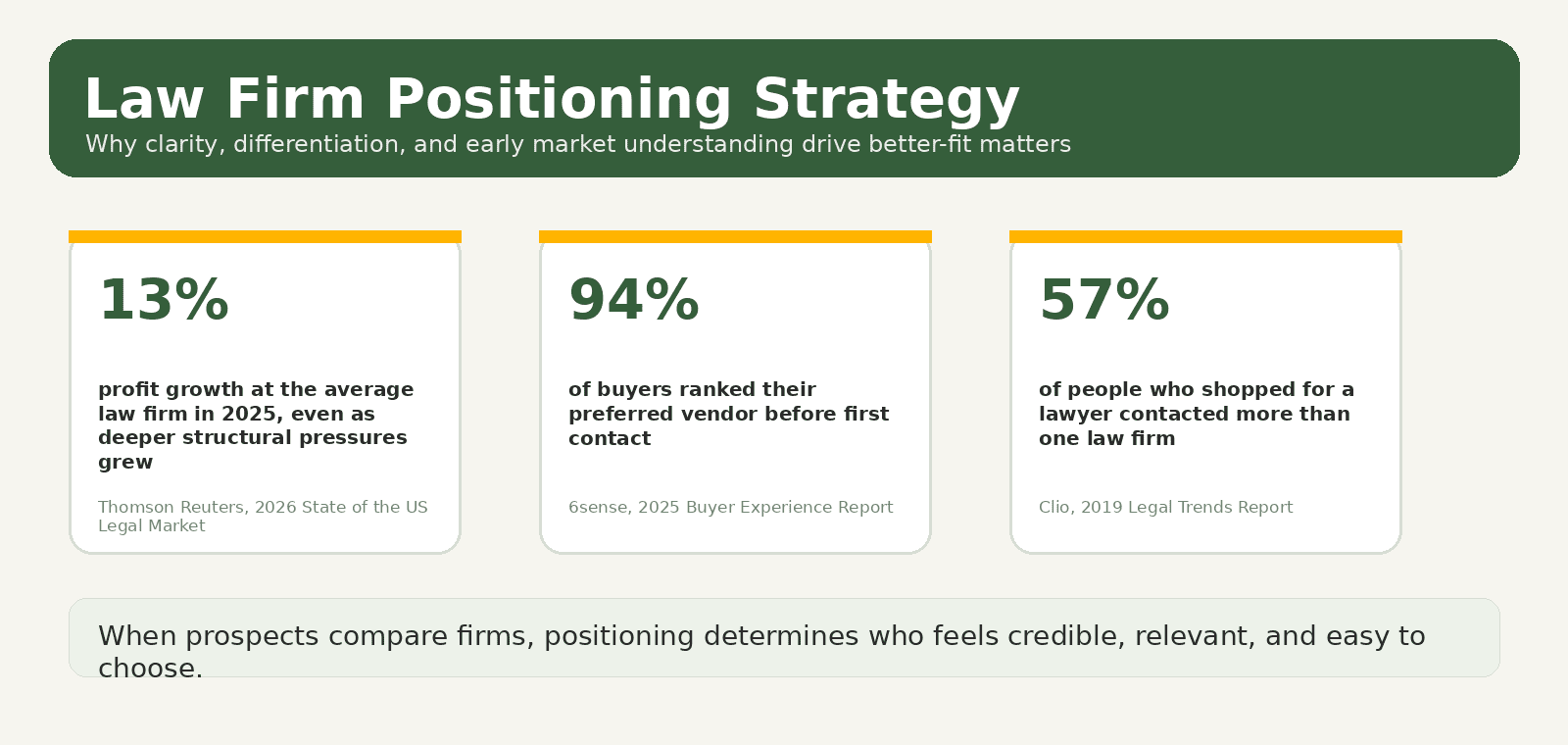
What Law Firm Positioning Strategy Really Means
Law firm positioning strategy is not a tagline exercise. It is the strategic work of defining how your firm should be understood in the market, who you are most relevant to, what you want to be known for, and why the right clients should choose you over credible alternatives.
Many firms confuse positioning with branding language. That is too narrow. Positioning shapes how your firm is interpreted everywhere it appears: on your website, in referrals, in search, in AI-generated summaries, in social content, and in the first thirty seconds of a conversation. If the market cannot quickly understand your relevance, your experience will not carry the weight you think it should.
Why Strong Firms Still Have Weak Positioning
Law firms rarely struggle because they lack substance. They struggle because they have not translated that substance into language the market can immediately understand.
They describe themselves too broadly
Phrases like “full-service,” “client-focused,” or “trusted counsel” are so common they do almost nothing to help a prospect distinguish one firm from another.
They lead with the firm, not the client
Many sites explain the firm’s credentials before they explain the client’s problem. That forces the buyer to work too hard to connect the dots.
They assume reputation will do the work
It will not. Reputation may open a door, but positioning determines whether the market understands why your firm matters now.
They overstate breadth
Trying to showcase everything often weakens the perception of expertise. The market reads broadness as lack of focus, even when that is not true.
They bury their real differentiators
The most persuasive elements of positioning are often hidden deep in bios, case examples, or conversations instead of being made visible early.
They sound interchangeable
When every firm uses the same claims, none of those claims create advantage. Positioning only works when it creates a clearer, sharper mental picture.
How Weak Positioning Hurts Growth
Positioning problems do not stay confined to messaging. They create downstream problems across visibility, conversion, referrals, and intake. If the market is unclear about who you are for, what you do best, or what makes you different, every other growth effort gets heavier.
Weak positioning can make a strong firm look generic. It can make a niche firm look broader than it should. It can make a high-value offering sound like a commodity. And in an AI-influenced market, weak positioning also makes your firm harder for machines to interpret and surface accurately.
Weak positioning often leads to
- lower-quality inquiries
- slower trust formation
- weaker referral clarity
- thin service-page performance
- reduced conversion on site
- difficulty standing out in competitive categories
What Strong Law Firm Positioning Looks Like
Strong positioning makes the right audience feel understood quickly. It also makes the firm easier to remember, easier to refer, and easier to choose.
Strong positioning is clear
- who the firm helps
- what matters or problems it handles
- where the firm has unusual strength
- why a client should trust it
- what makes the approach or perspective distinct
Strong positioning is disciplined
- it does not try to speak to everyone
- it avoids generic legal jargon
- it aligns language across the site
- it reinforces priority service lines
- it supports both human understanding and search visibility
Questions to Ask About Your Firm’s Positioning
Clarity questions
- Can a prospect understand our relevance in seconds?
- Do our top pages explain the client problem before the firm story?
- Would someone outside our firm describe us the same way we describe ourselves?
- Do our pages sound precise or generic?
Strategic questions
- Are we trying to be known for too many things at once?
- Are our strongest differentiators visible early enough?
- Does our language support the markets we most want to win?
- Would a referral partner know exactly how to introduce us?
How Positioning Connects to the Larger Growth Framework
Positioning is not a standalone exercise. It strengthens the entire growth system.
See how positioning fits into the broader framework of visibility, website clarity, intake, client experience, and strategic alignment.
Diagnostic Clarity AuditUse the Clarity Audit to identify where positioning, visibility, and conversion are creating uncertainty or holding growth back.
Supporting Page Law Firm IntakePositioning shapes the quality of the inquiries you attract. Intake determines what happens once those inquiries arrive.
Supporting Page Strategic Repositioning and Growth PlanningSee how market focus, strategic clarity, and positioning work together when a firm is ready to sharpen its growth direction.
Frequently Asked Questions About Law Firm Positioning Strategy
What is law firm positioning strategy?
Law firm positioning strategy is the process of defining how a firm should be understood in the market, who it is most relevant to, what it wants to be known for, and why the right clients should choose it over competing alternatives.
Why is positioning important for law firms?
Positioning matters because legal buyers often form opinions before they ever call. If a firm’s relevance is unclear, its expertise may be overlooked, misunderstood, or treated like a commodity.
How is positioning different from branding?
Branding is how a firm looks, sounds, and feels. Positioning is the strategic foundation that determines how the firm should be understood and remembered in the market. Strong branding without strong positioning can still leave the market confused.
Can better positioning improve SEO and AEO?
Yes. Stronger positioning improves the clarity and consistency of language across your site, which helps both people and search systems better understand what your firm does, who it serves, and why it is relevant.
What is the first step to improve law firm positioning?
The first step is to diagnose where the message is creating confusion. A structured review such as the Clarity Audit can help identify whether the problem is market focus, messaging, service-page language, credibility signals, or conversion structure.
Positioning should make your expertise easier to choose
When your firm’s positioning is clear, everything else works harder. Visibility improves. Trust forms faster. Referrals become sharper. Conversion gets easier.
If your firm is stronger than the market currently understands, start with the Clarity Audit.