The positioning is too broad
Generic practice-area language makes it difficult to understand which matters, clients and problems the firm is genuinely best equipped to handle.

Prospective clients are using Google AI Overviews, ChatGPT and other answer engines to understand their legal problem, compare firms and form a shortlist before they ever visit a law firm website.
Precision Practices helps law firms identify the gaps that keep their expertise out of those answers, then builds a practical roadmap to make the firm easier for both people and AI systems to interpret and trust.
Traditional SEO helped firms earn a place in a list. AI-driven search increasingly interprets the question, synthesizes evidence and presents a smaller field of sources or firms.
The searcher reviewed a wider list of results, visited several websites and did more of the comparison themselves. Visibility was primarily measured through rankings, traffic and clicks.
The answer engine interprets, summarizes and narrows the field before many users visit a website. Clear expertise, verifiable authority and consistent digital signals become part of the selection process.
A firm can be excellent in practice and still be difficult for the market or an AI system to interpret. The disconnect is usually created by weak reinforcement across the website and the broader digital ecosystem.
Generic practice-area language makes it difficult to understand which matters, clients and problems the firm is genuinely best equipped to handle.
Case leadership, representative work, awards, media coverage and attorney credentials may exist, but remain isolated in bios, press archives or scattered pages.
Reviews, directories, profiles, media mentions and branded search results fail to reinforce the same clear expertise and authority presented on the website.
AEO is not a replacement for SEO and it is not a single technical tactic. It is the alignment of positioning, content, structure and corroborating proof.
Your firm should be immediately understandable in terms of the matters it handles, the clients it serves and the situations in which it should be considered.
Content should answer the questions legal buyers actually ask and connect those answers to the firm’s relevant experience, not merely describe a list of services.
Reviews, representative matters, leadership roles, awards, media coverage, published insights and attorney credentials should be visible, current and connected to specific expertise.
Clear headings, logical page architecture, structured data and consistent entity signals help search engines interpret the firm accurately instead of forcing them to guess.
Intentional internal linking connects related practices, attorney experience, proof and insights so the depth of the firm’s authority is visible across the site.
The website, attorney profiles, reviews, directories, media mentions and published content should reinforce the same story wherever a prospect or AI system looks for confirmation.
The audit evaluates six areas across a 240-point framework. It translates a complex visibility problem into a clear assessment of what is working, what is weakening trust and what should be fixed first.
These executive white papers examine how prospective clients use AI before contacting a law firm and why capable firms can disappear from the early shortlist.
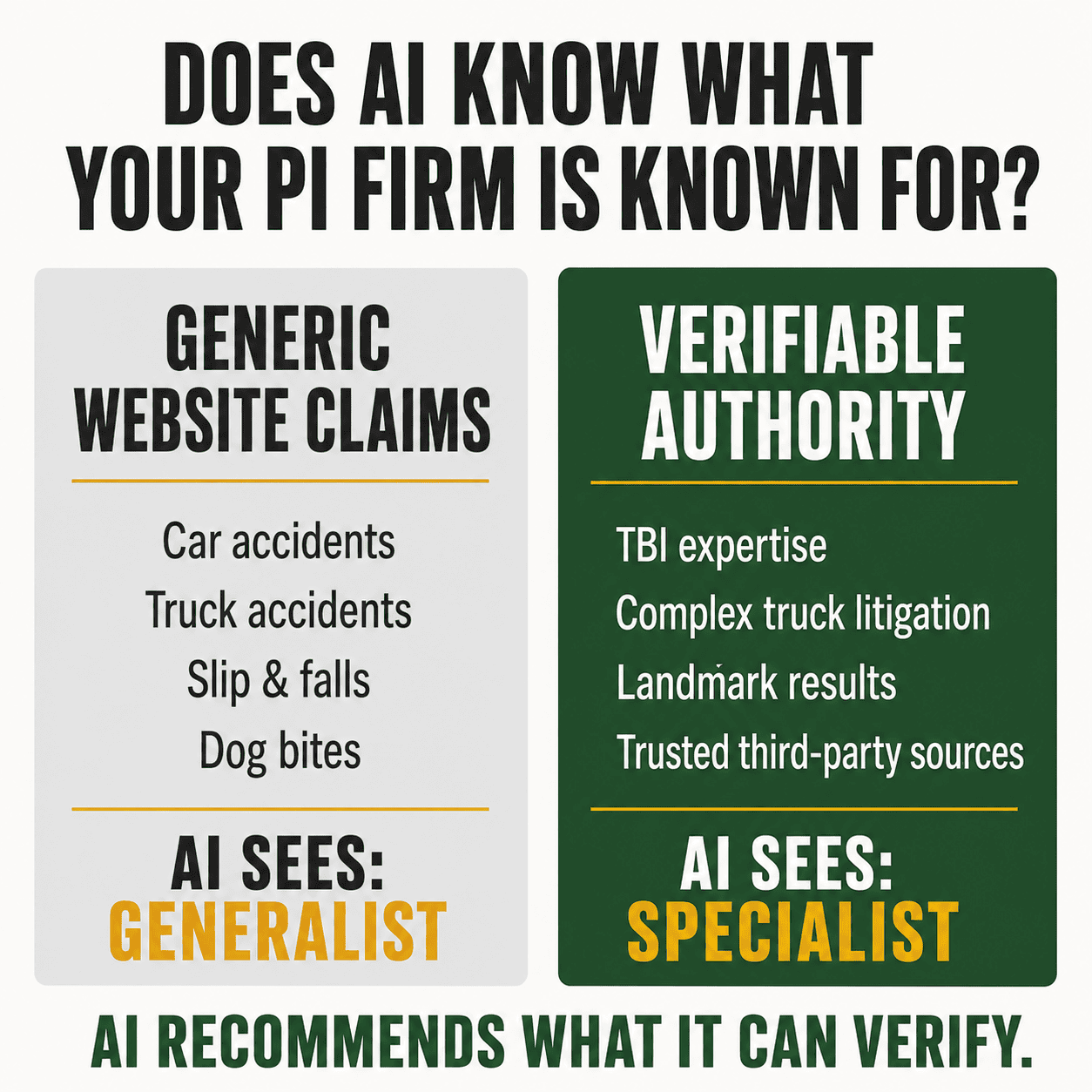
Learn how injured consumers use AI to assess urgency, fault and potential attorneys before a law firm receives the first call.
Read the Personal Injury Paper
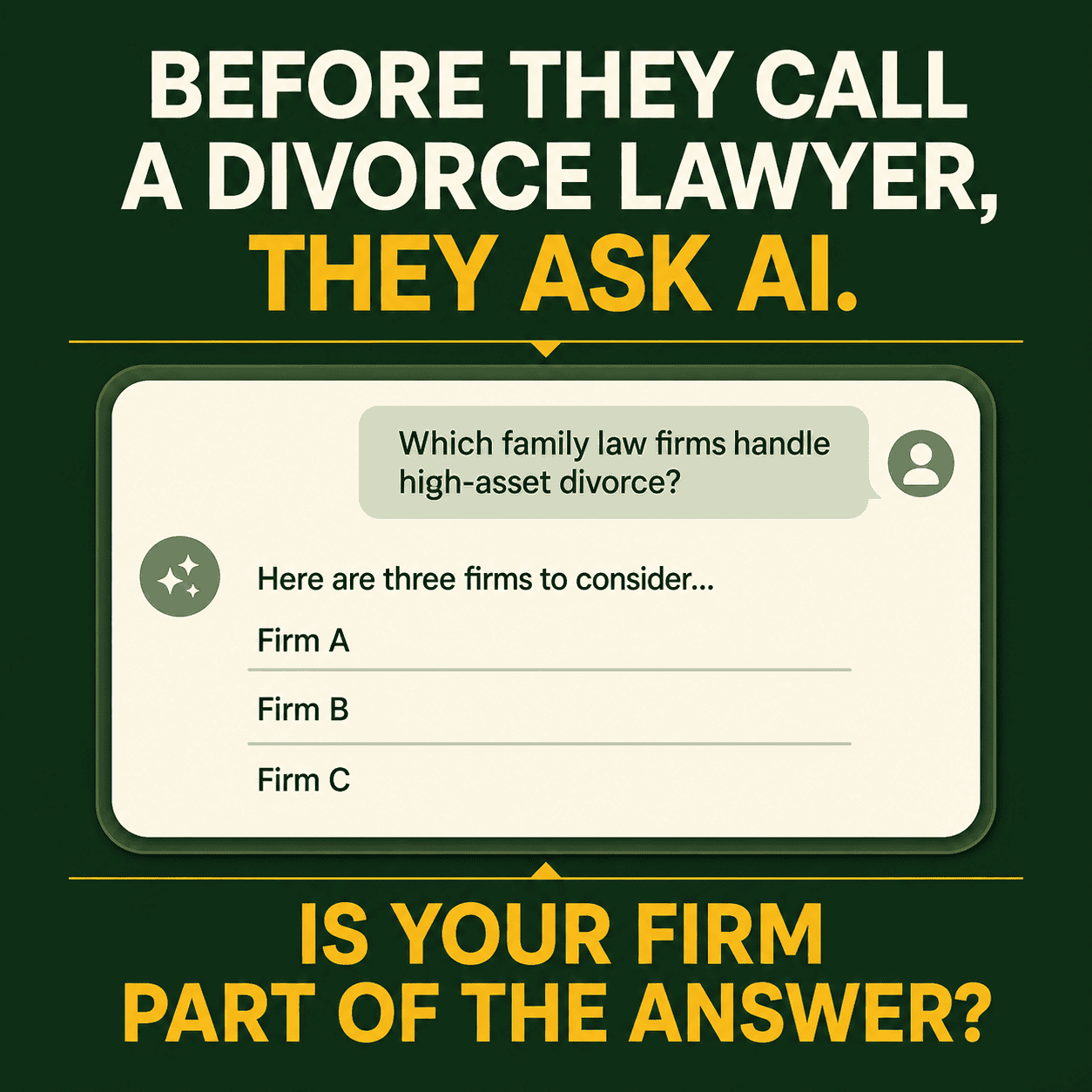
See how private, high-stakes questions about divorce, custody and significant assets shape the shortlist before a prospective client reaches out.
Read the Family Law PaperAI visibility is the extent to which a law firm’s expertise, authority and relevance can be found, interpreted, validated and surfaced in AI-generated answers. It includes the firm’s website as well as reviews, directories, media mentions, attorney profiles and other third-party signals.
AEO stands for Answer Engine Optimization. For law firms, it means making expertise easier for search engines and AI systems to understand, verify and recommend through clear positioning, direct-answer content, structured information and corroborating authority signals.
No. SEO remains an important foundation for technical health, local relevance, rankings and discovery. AEO adds the clarity, structure and evidence needed for a firm to be considered inside direct answers and AI-assisted recommendations.
AI systems may give significant weight to relevance, interpretability and verifiable authority, not proximity alone. A firm with clearly defined expertise and stronger supporting evidence can be easier to categorize and recommend than a closer firm with broad or inconsistent signals.
Reviews, media coverage, directories, awards and other independent sources help corroborate a firm’s experience and reputation. When those signals are current, consistent and connected to clearly defined expertise, they give prospective clients and AI systems more confidence in the firm.
Clear positioning, direct answers, strong page hierarchy, useful attorney profiles, structured data, intentional internal links, visible proof and consistent language across the digital ecosystem all make a law firm easier to interpret.
The audit evaluates how clearly the firm communicates its expertise, whether its authority can be verified, how well its content answers real questions, whether its website is machine-readable and how consistently its external profiles and proof reinforce the same story.
Start by identifying how the firm is currently being interpreted. An audit prevents the firm from investing in more content or technology before it understands whether positioning, proof, structure, reviews or another foundational signal is causing the visibility gap.
Find out whether your firm’s expertise is clear enough to be understood, trusted and recommended in the AI layer of legal discovery.
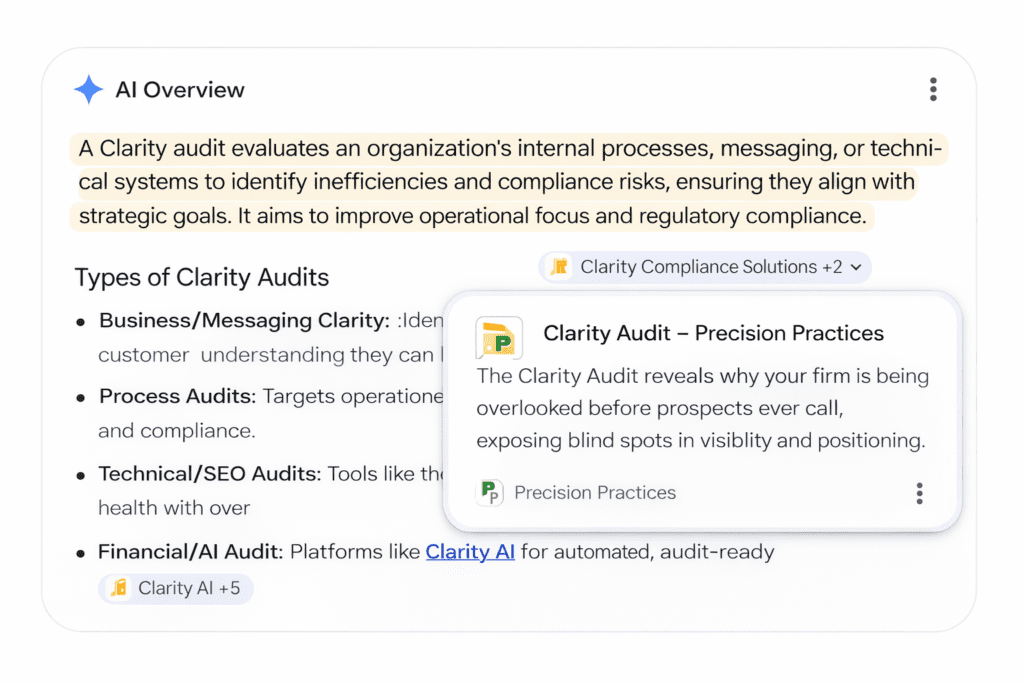
AI Overviews for law firms are AI-generated summaries in Google search that recommend a small number of firms based on how clearly their expertise, authority, and content can be understood.
They reduce the number of firms a user considers and shift visibility from rankings to selection
AI Overviews are already changing how legal search works. Studies show that when AI summaries appear, top-ranking pages can lose more than half of their click-through rate. At the same time, most searches now end without a click, as users get answers directly from Google.
Instead of reviewing a full page of results, users are increasingly shown a smaller set of recommended sources. That means fewer firms are considered from the start.
Top-ranking pages can lose up to 60% of clicks when AI Overviews appear, according to an Ahrefs study.
More than half of Google searches now end without a click, according to a SparkToro and Datos analysis.
AI Overviews typically surface only a small number of sources, reducing how many firms a user considers before making a decision.
Traditional legal SEO was built around the idea that visibility meant appearing in a list of blue links, local pack results, or map listings. That model is changing. AI Overviews compress the decision process by summarizing answers and surfacing a smaller set of firms or sources before a searcher ever explores the broader field.
In the older search model, a prospective client might scan multiple firms, compare websites, and decide who looked strongest. AI Overviews reduce that exploratory behavior by summarizing the issue and presenting a smaller field of likely options.
For law firms, that means fewer chances to be discovered simply by being nearby or appearing somewhere on page one. The first layer of evaluation is now happening earlier and more aggressively.
Local SEO still matters, but it is no longer the whole game. If Google cannot clearly interpret your practice focus, trust signals, and relevance to the search, your firm may be overlooked even in searches that feel geographically favorable.
The firms that benefit are often the ones whose authority is easier to categorize, easier to verify, and easier to summarize.
This is not just a traffic shift. It is a decision shift. When AI Overviews appear, law firms are increasingly being evaluated inside the answer itself. That means the firms most likely to win are not always the ones with the biggest footprint or the closest office. They are often the ones that make their expertise easiest for Google to interpret and recommend.
Local SEO still matters. Google Business Profile, reviews, location signals, and local relevance are not going away. But they are no longer enough on their own to protect visibility in a search environment where Google increasingly summarizes, filters, and narrows the field before a searcher explores the broader result set.
In traditional search, a user often scanned several firms before deciding which ones looked strongest. AI Overviews change that by providing a summarized answer and a narrower set of cited options up front.
When fewer firms are surfaced first, the cost of not being included rises quickly. It is no longer enough to simply appear somewhere in the broader results.
A law firm that is slightly farther away but more clearly positioned may be easier for Google to categorize and recommend than a closer firm with vague messaging or broad positioning.
That is why some firms are starting to appear in searches that historically would have favored a more local competitor. The search engine is weighing interpretability more heavily.
Many law firm websites still try to sound comprehensive rather than specific. That may feel safer internally, but it creates a real problem in AI-driven search. Broad language gives Google less confidence about when and why your firm should be surfaced. According to an Ahrefs study on AI Overviews and click-through rates, top-ranking pages can lose a significant share of traffic when AI summaries appear.
The clearer your practice focus and authority signals, the easier it is for AI systems to connect your firm to a specific search intent.
If your site lacks strong content hierarchy, direct-answer copy, internal linking, and machine-readable signals, Google has to work harder to understand what your firm actually does and where it is strongest. As Google explains in its overview of AI-powered search, results are increasingly summarized and synthesized before users explore individual websites.
In AI-driven search, that uncertainty is expensive. Firms with better structure make it easier for Google to interpret and cite them. Firms without it risk being overlooked even when they have the capability.
Local SEO is still part of the foundation, but it is no longer the whole strategy. Law firms that want to remain visible in AI Overviews need more than location relevance. They need clear positioning, structured content, strong trust signals, and a site architecture that helps Google understand exactly when their firm should be recommended.
AEO stands for Answer Engine Optimization. For law firms, it means structuring your website and digital presence so search engines and AI systems can confidently understand, validate, and surface your expertise when someone asks a legal question.
Traditional SEO helps your law firm appear in a list of results. AEO helps your law firm become part of the answer.
That distinction matters because AI Overviews are changing how legal consumers discover firms. Instead of just scanning links, users are increasingly receiving summarized guidance first. If your firm is not clearly structured to be interpreted and cited, you may lose visibility before a user ever clicks.
AEO for law firms is the practice of making your legal expertise easier for AI systems and search engines to understand, trust, and recommend through clear positioning, direct-answer content, structured data, and strong supporting authority signals.
Structured content helps Google understand your site. If yours is unclear, visibility suffers. See this SEO case study .
AEO focuses on making your expertise easy to extract, summarize, verify, and recommend when Google or another AI-driven system is generating a direct response.
AEO is not a replacement for SEO. It is the next layer of visibility. Law firms still need strong local SEO, practice area pages, reviews, and technical health. But to compete in AI Overviews, they also need clearer positioning, more direct-answer content, better structure, and authority signals that are easier for Google to interpret with confidence.
If AI Overviews are shaping what prospective clients see first, then visibility depends on more than rankings. It depends on how clearly your firm can be interpreted, trusted, and recommended. This is the structure that supports that outcome.
Your firm needs to be immediately understandable. Not broadly capable, but clearly defined. AI systems perform better when they can confidently match your firm to a specific type of case, client, and problem.
Content that directly answers real legal questions is easier for AI to extract and summarize. Pages that explain, define, and guide tend to perform better than pages that simply describe services.
Reviews, results, citations, and recognition all contribute to trust. The more consistent and visible these signals are across the web, the easier it is for AI to validate your credibility.
Schema, clear headings, and logical page structure help search engines interpret your content accurately. Without this, even strong content can be underutilized.
Strong internal linking connects your authority across pages. It signals depth, consistency, and topical ownership, all of which help AI systems understand where your firm is strongest.
Visibility alone is not enough. Once someone lands on your site, your messaging, structure, and next steps must continue to reduce uncertainty. This is where many firms still lose momentum.
AEO is not a single tactic. It is the result of aligning positioning, content, structure, and trust signals into something that both humans and machines can understand quickly. Firms that do this well are easier to recommend, not just easier to find.
This is where the shift becomes real. In certain legal searches, AI Overviews are already surfacing firms that are not the closest geographically, but are easier for Google to interpret and explain.
In this example, a high-intent legal query tied to a specific geography returns an AI Overview that includes firms outside the immediate area. Under the traditional model, proximity would have played a much stronger role in what appeared first.
What has changed is not the importance of location, but the weight given to clarity. The firms being surfaced are easier for Google to understand. Their positioning is more specific. Their content is more structured. Their authority signals are easier to validate.
AI systems are synthesizing information across multiple sources and selecting what appears to be the most relevant and trustworthy answer. If your firm’s expertise is harder to interpret, it may be excluded even if it is geographically closer or equally capable.
In AI-driven search, clarity of expertise can outweigh proximity. Law firms that are easier for Google to understand, categorize, and explain are more likely to be surfaced inside AI Overviews, even in searches that historically favored local competitors.
Ranking in traditional search is no longer enough. The firms gaining ground in AI Overviews are not always the biggest firms or the ones closest to the searcher. They are often the firms whose websites make expertise easier for machines to interpret, trust, and surface. This audit is designed to show where your firm stands today and how likely your site is to be considered in the AI layer of search.
The AEO Visibility Audit evaluates whether your website is sending the right signals for AI-driven search. It looks beyond basic SEO and focuses on the structural, topical, and trust factors that influence whether your firm is likely to appear in AI-generated answers.
If you want to know how your site is likely to perform in AI Overviews, submit your information below. I will review the website through the lens of answer engine optimization, content clarity, and machine-readable authority signals.
If AI Overviews are already shaping visibility in your market, waiting is not a strategy. The firms that move first are not doing more marketing. They are making their expertise easier to understand, easier to trust, and easier to recommend.
Narrow your focus so Google can clearly connect your firm to specific types of cases and clients.
Create pages that answer real legal questions directly instead of just describing services.
Use clear headings, schema, and logical page organization to make your content easier to interpret.
Make your results, reviews, and recognition more visible and consistent across your site and the web.
Connect your expertise across pages so Google understands your depth and specialization.
Look at how your firm is actually being interpreted, not just how it performs in isolated metrics.
Most firms are not losing because they lack expertise. They are losing because that expertise is not being clearly understood early enough. A Clarity Audit shows where your firm is being filtered out before a prospect ever reaches out.
Request a Clarity AuditThis is what makes the shift to AI Overviews different from previous changes in search. In the past, visibility problems were easier to spot. Rankings dropped. Traffic declined. Calls slowed down. There were signals you could react to.
That is not how this works.
When AI Overviews filter and summarize results, your firm can lose visibility without any obvious warning. You may still rank. Your analytics may still show traffic. But the most qualified prospects may never reach your site because they were guided somewhere else before they ever had the chance.
From the outside, nothing looks broken. From a growth perspective, something clearly is.
The firms that are winning are not always the ones doing the most marketing. They are the ones that are easiest to understand, easiest to trust, and easiest for Google to recommend. When that happens, visibility increases, conversion improves, and growth becomes easier to sustain.
These are the questions law firm leaders are starting to ask as Google shifts from showing lists of results to generating answers. The clearer these answers are on your site, the easier it becomes for search engines and AI systems to understand your authority.
AI Overviews are AI-generated summaries that appear at the top of some Google search results. Instead of showing only traditional links, Google may answer the question directly and cite a smaller set of sources or firms.
They matter because they shape visibility before a prospective client clicks through to a website. If your firm is not clearly understood by Google, you may be excluded from the answer even if you are credible, local, and experienced.
Yes. Local SEO still matters. Google Business Profile, location relevance, reviews, and local signals remain part of the foundation. But local SEO alone is no longer enough if your firm is not also structured to be clearly interpreted in AI-driven search.
AEO stands for Answer Engine Optimization. For law firms, it means creating content and site structure that help search engines and AI systems understand, trust, and recommend your expertise when users ask legal questions.
Because AI Overviews may prioritize clarity of expertise over pure proximity. If a non-local firm is easier for Google to categorize, verify, and summarize, it may be surfaced ahead of a closer competitor with broader or less structured content.
Clear positioning, direct-answer content, strong headings, schema, internal linking, visible authority signals, and consistent language across the site all make a law firm easier for AI systems to interpret with confidence.
Law firms can improve their chances by tightening positioning, publishing direct-answer content, improving page structure, strengthening internal linking, making authority signals more visible, and aligning their site around clear practice area expertise rather than generic service language.
If your firm still relies mainly on local rankings, broad messaging, and generic practice area content, there is a real chance AI-driven search is already reducing your visibility. The risk is often hard to see because it shows up as lost consideration before a prospect ever reaches out.
Start by clarifying what your firm is truly best known for, then build content and structure around that expertise. Most firms do not need more noise. They need clearer signals that help Google and potential clients understand why they should be chosen.
The firms that adapt fastest will not just protect visibility. They will be easier to recommend. That is the real shift. AI Overviews are changing how legal buyers discover firms, and the winners will be the ones whose expertise is easiest to understand, trust, and explain.
From Hustle to Harmony: Building a Business Clients Love