For years, law firms have been taught a relatively simple model of visibility. Rank higher, generate more clicks, and convert more of those opportunities into clients. It was never quite that simple, but it was directionally right.
That model is breaking down.
Today, in a growing number of high-intent searches, users are not starting with a list of firms. They are starting with an answer. Google summarizes the issue, frames the options, and surfaces a small number of firms before a user ever clicks through to a website.
That changes the nature of competition entirely.
The question is no longer which firms rank. The question is which firms are understood well enough to be selected.
What AI Overviews for Law Firms Are Actually Doing
AI Overviews for law firms are AI-generated summaries in Google search that recommend a small number of firms based on how clearly their expertise, authority, and content can be understood.
They reduce the number of firms someone even considers and, in doing so, shift visibility from rankings to selection.
If you have not looked at this shift closely, this detailed breakdown of AI Overviews for law firms walks through what is happening and why it is accelerating.
Why Some Firms Show Up and Others Don’t
This is the part that tends to surprise people.
Selection is not random, and it is not simply a reflection of who has the strongest credentials or the most experience. Google is trying to reduce uncertainty. It is prioritizing firms it can understand quickly and recommend with confidence.
When a site makes that easy, it gets surfaced. When it does not, it gets filtered out, often before a user ever knows it exists.
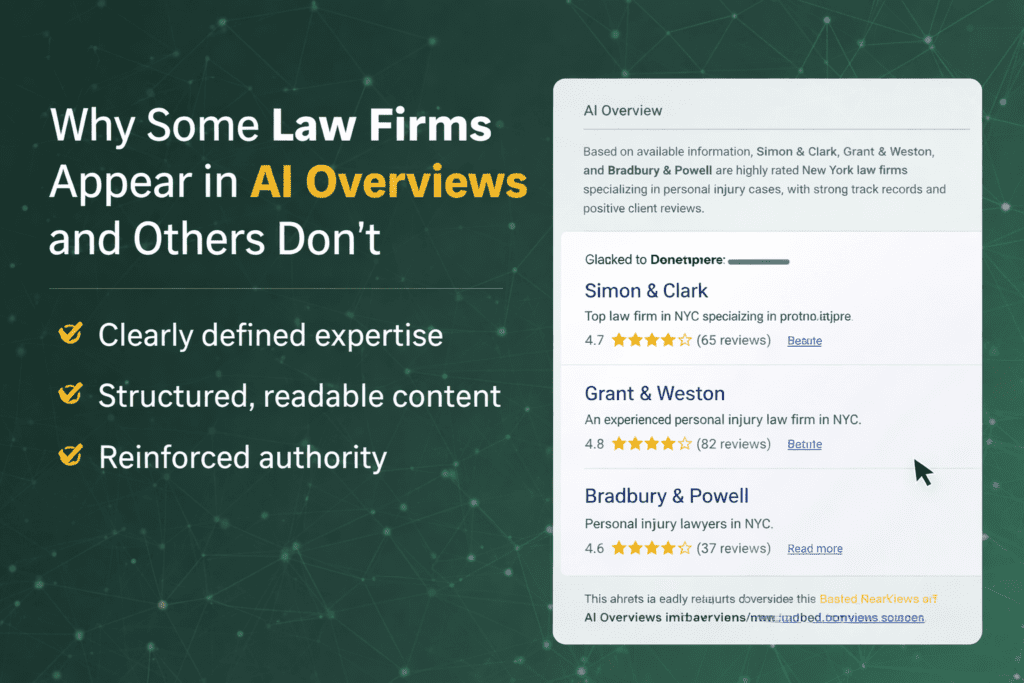
In practical terms, the difference comes down to three things that show up consistently across firms that are being included versus those that are not.
The Three Factors That Drive Selection
1. Clarity of expertise
Most firm websites are built to cover everything. Multiple practice areas, broad descriptions, and language that tries to speak to every possible client.
That approach creates ambiguity.
AI systems respond to clarity. They favor firms that communicate, in plain terms:
- what they do
- who they help
- and when they are relevant
In many cases, the underlying expertise is strong, but the way it is presented makes it harder to interpret. That is typically what surfaces in a Clarity Audit for AI Overviews visibility, where the gap is not capability, but how that capability is expressed.
2. Structure that is easy to interpret
Content now needs to work on two levels. It needs to be persuasive for a human reader, and it needs to be interpretable for a system that is trying to categorize and connect information.
That puts pressure on structure.
Pages that perform well tend to have a clear flow, consistent terminology, and a logical progression of ideas. Headings align with content, sections build on each other, and the overall narrative holds together.
When structure breaks down, confidence drops. When confidence drops, the likelihood of being selected drops with it.
3. Reinforcement across the site
One strong page is not enough to establish authority.
AI Overviews are not built from a single source. They are built from patterns across multiple sources, and your own site is part of that pattern. When multiple pages reinforce the same positioning, use consistent language, and point in the same direction, it becomes easier for Google to trust what it is seeing.
This is why a focused page like
AI Overviews for law firms works best when it is supported by related content rather than standing on its own.
What Happens When This Is Missing
When clarity is inconsistent, structure is uneven, and nothing reinforces anything else, the outcome is not subtle.
Firms are not just pushed down in rankings. They are removed from consideration earlier in the process. They do not appear in the summary, they are not part of the shortlist, and they are not given the opportunity to compete.
From the outside, this often looks like a traffic problem.
In reality, it is a visibility problem that occurs before traffic is even possible.
This shift is already measurable. According to an
Ahrefs study on AI-generated search results, top-ranking pages can lose a significant share of clicks when AI summaries appear.
What To Do Next
The instinctive response is to do more. More content, more keywords, more pages.
That is rarely the right answer.
The firms that are beginning to show up consistently are not producing more. They are making it easier to understand who they are, what they do, and when they are the right choice.
That usually starts with clarity, then moves to structure, and then to reinforcement across the site.
If you want a practical starting point, this Clarity Audit is designed to identify where that process is breaking down and where visibility is being lost before a prospect ever clicks.
FAQs About AI Overviews for Law Firms
What are AI Overviews for law firms?
AI Overviews for law firms are AI-generated summaries in Google search that recommend a small number of firms based on how clearly their expertise and content can be understood.
Why do some law firms appear in AI Overviews?
Firms appear when their expertise is clearly defined, their content is well-structured, and their authority is reinforced across multiple pages.
Final Thought
AI Overviews for law firms are not a temporary shift. They represent a structural change in how legal services are discovered and evaluated.
This is not a ranking problem.
It is a selection problem.
And the firms that recognize that shift early, and adjust how they present themselves accordingly, are the ones that will continue to be seen.