The Shift in Search: From Rankings to Recommendations
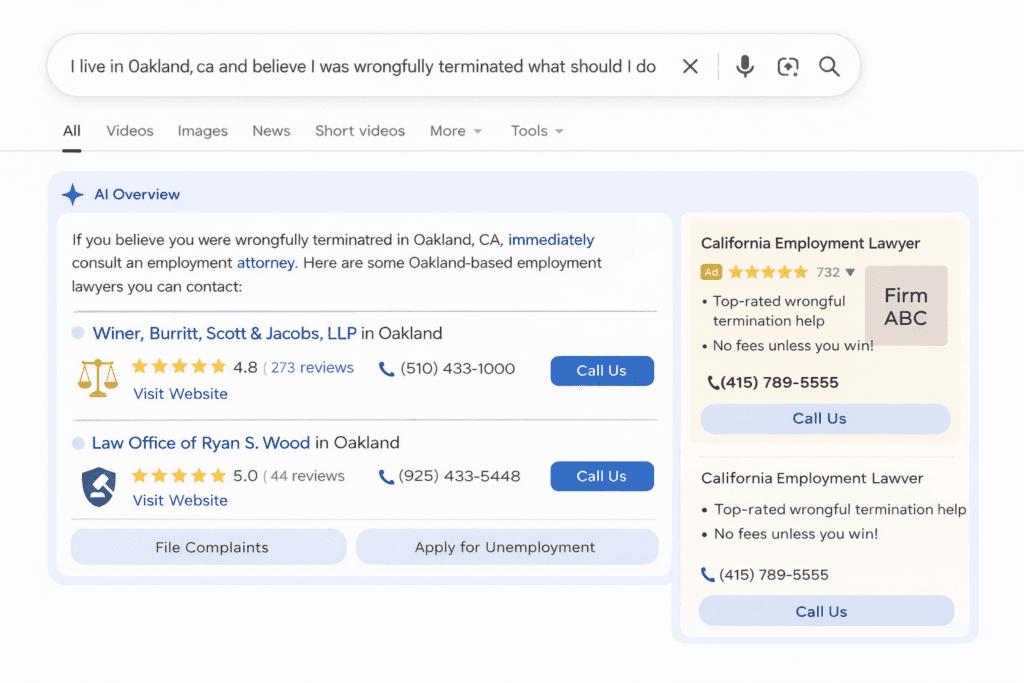
A search like:
“I was wrongfully terminated in Oakland, CA and need an employment lawyer”
…used to be a “home game” for local firms. Proximity was king. If your office was on Broadway or Telegraph Ave, you won.
That model is breaking.
Today, AI Overviews sit at the top of the SERP (Search Engine Results Page). They don’t just list firms; they curate them. AI is now:
Synthesizing answers instead of providing a list of options.
Surface-level filtering: Showing 2–3 firms instead of the traditional “Map Pack.”
Ignoring zip codes: Prioritizing “Clarity of Expertise” over physical distance.
We are seeing firms in San Francisco—or even Los Angeles—surface for Oakland searches. Not because they are better lawyers, but because they are more understandable to AI.
What is AEO for Law Firms?
Answer Engine Optimization (AEO) is the practice of structuring a law firm’s digital footprint so AI models (like Google Gemini, Perplexity, and GPT-4) can confidently interpret, verify, and recommend their services. While SEO focuses on ranking in a list, AEO focuses on being the single answer provided to a user.
Why “Local” SEO is Failing Oakland Firms
For a decade, the playbook was: Build a page, mention “Oakland” ten times, get five reviews. But AI doesn’t “browse” your site like a human; it parses it for data. This is why a traditional law firm positioning strategy is often the first thing that needs to change. Most sites fail the AI evaluation because of…
Semantic Noise: Your site tries to be “everything to everyone,” which AI interprets as “nothing to anyone.”
The Proximity Gap: AI assumes a high-authority firm 10 miles away is a better recommendation than a low-authority firm 1 mile away.
Missing Data Structures: If your site lacks
LegalServiceschema, the AI is essentially guessing what you do.
The shift is simple but brutal: You are no longer competing to rank. You are competing to be selected.
The New Visibility Stack: Optimizing for AI Recommendations
To remain visible, your firm must pivot from “Keywords” to “Entities.”
1. From Keywords to Verifiable Authority
AI cross-references your site with the “Real World.” It checks your State Bar profile, your LinkedIn, and your mentions in legal directories. If your website claims you are a “Top Oakland Wrongful Termination Lawyer” but your digital footprint is silent, the AI loses confidence. *
Action: Ensure your practice area signals are consistent across the entire web, not just your homepage.
2. High-Utility “Direct Answer” Content
AI Overviews love the “Answer-Context-Evidence” framework.
Ineffective Content: A 2,000-word blog post about the “History of Labor Law.”
AEO Content: “How long do I have to file a wrongful termination claim in California?” Followed immediately by: “In California, the statute of limitations is generally three years, but DFEH/EEOC filings often require action within 180 days.”
3. Machine-Readable Schema
You must speak the AI’s native language. Using Structured Data (specifically standards from Schema.org) is like giving the AI a cheat sheet. It tells the AI exactly what laws you practice and which jurisdictions you serve without the machine having to guess.
LegalService Schema: Tells AI exactly what laws you practice.
AreaServed Schema: Defines your jurisdiction so you aren’t filtered out of local queries.
FAQ Schema: Directly feeds the AI the answers it wants to display in the Overview.
The Hidden Risk: Silent Revenue Loss
This is a selection problem, not a traffic problem.
When AI answers a prospect’s question and points them toward a competitor, that prospect never clicks your link.
You won’t see a “drop” in rankings.
Your Analytics might even look “fine.”
But your phone stops ringing.
You are losing cases you never knew existed because you were never in the “Consideration Set” to begin with.
Is Your Firm Built to Be Recommended?
The question for 2026 isn’t “Where do we rank?” it’s “Would AI confidently recommend us?”
If your messaging is vague, your technical SEO is outdated, or your expertise is buried in long paragraphs, the answer is likely “No.”
Next Step: The Clarity Audit
We built the Clarity Audit to solve this. It evaluates your law firm visibility in the AI era, identifying where your messaging creates “friction” for models like Google Gemini.
AI Confidence: How easily a machine can categorize your firm.
Positioning Gaps: Where your messaging creates “friction” for AI models.
AEO Readiness: Whether your technical structure is helping or hurting your visibility.
Final Thought
Local SEO was never wrong; it’s just no longer enough. The firms that adapt to how AI makes decisions will pull ahead. Those that don’t will remain invisible—no matter how close their office is to the courthouse.
Frequently Asked Questions About AI Overviews and Law Firm Visibility
Google AI Overviews are changing how potential clients discover and evaluate law firms. These questions address what that means for local SEO, AEO, and law firm visibility.
Google AI Overviews are AI-generated summaries that appear at the top of some search results. Instead of showing only traditional organic listings, Google may answer the question directly and cite a smaller number of sources or firms. That means users can make decisions before ever clicking through to a website.
AI Overviews are reducing the visibility of traditional local SEO results by taking up more space on page one and narrowing the number of firms a searcher sees first. A law firm can still rank locally, but if it is not clear enough for AI to understand and recommend, it may be displaced by firms outside the immediate area.
AEO stands for Answer Engine Optimization. For law firms, it means structuring website content so AI systems can easily interpret the firm’s expertise, geography, authority, and relevance to a specific legal question. SEO helps a firm get found. AEO helps a firm get selected.
AI Overviews do not rely on proximity alone. They often prioritize firms whose websites communicate expertise more clearly, use stronger authority signals, and provide more machine-readable answers. As a result, a firm outside Oakland may appear if Google’s AI views that site as easier to understand and more trustworthy for the search.
Yes, but it is no longer enough on its own. Local SEO still matters for map pack visibility, geographic relevance, and traditional organic rankings. The problem is that potential clients now often encounter AI-generated recommendations before they ever reach those listings.
Clear practice area pages, direct answers to common legal questions, consistent geographic references, structured headings, strong internal linking, and schema markup all help. AI is looking for confidence signals. If a firm’s site is vague, broad, or poorly structured, it becomes harder for AI to recommend it.
Law firms can improve AEO by tightening their positioning, answering client questions directly, improving technical structure, strengthening internal links, and using schema markup to clarify services and locations. The goal is not simply to publish more content. It is to make expertise easier for both people and machines to understand.
If your firm ranks locally but is not appearing in AI-driven results, or if your site still relies on broad messaging and outdated content structure, there is a good chance visibility is being lost before a prospect ever reaches your website. That is exactly the kind of issue a clarity and visibility audit is designed to uncover.
From Hustle to Harmony: Building a Business Clients Love