
Law Firm Visibility in the AI Era
Law firm visibility in the AI era is no longer about whether your website exists or whether your firm shows up somewhere in search. It is about whether your expertise can be found, interpreted, trusted, and surfaced in a market where discovery now happens earlier, through more channels, and with less patience for ambiguity.
A firm can be highly capable and still remain far less visible than it should be. That happens when search visibility, review strength, page clarity, authority signals, and machine-readable trust are too weak to reinforce one another.
What this page covers
- Why law firm visibility has changed
- How SEO, AEO, reviews, and authority signals connect
- Why machine-readable trust matters now
- How strong firms still get overlooked
- What visibility improvements matter most
Why Law Firm Visibility Has Changed
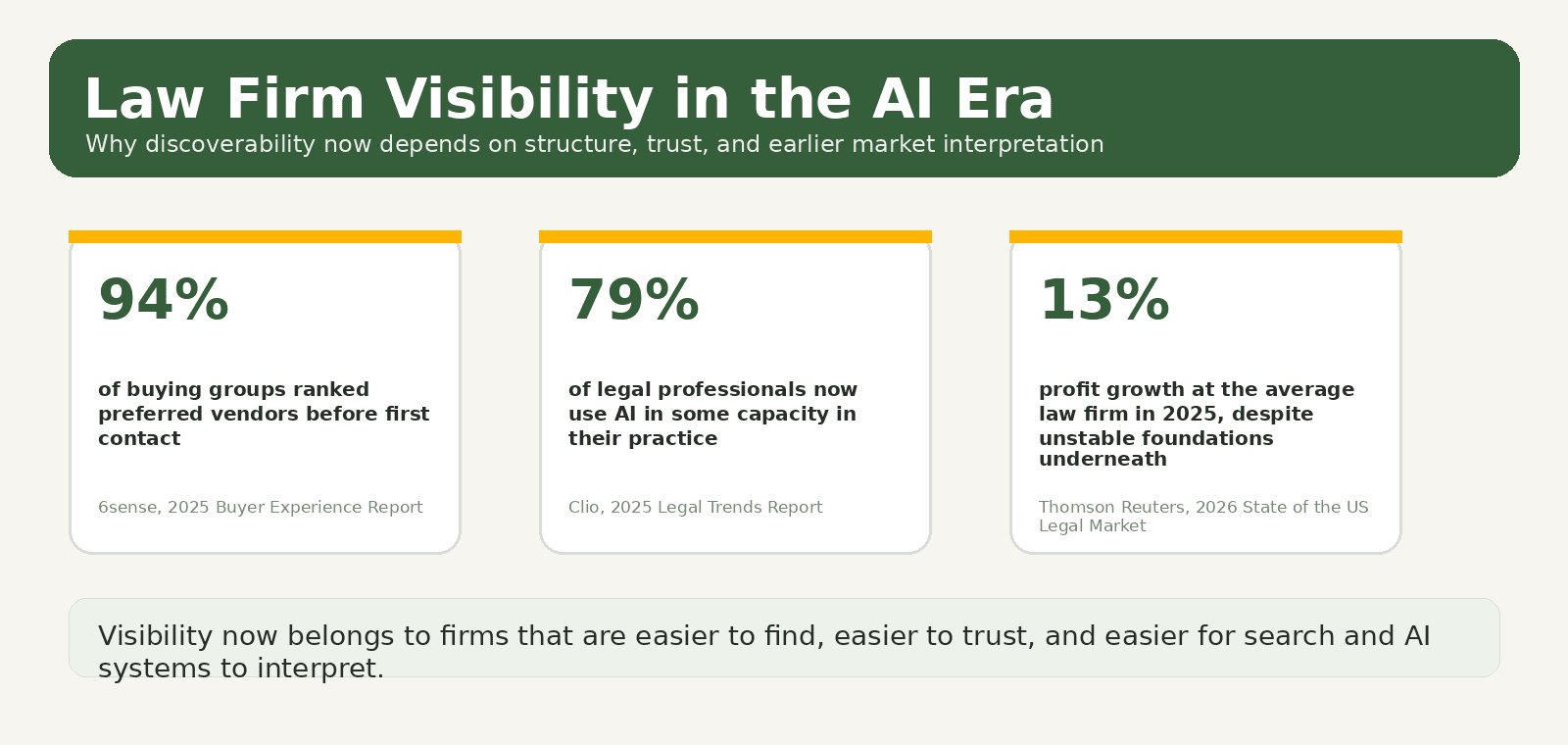
The old visibility model assumed that prospective clients searched, clicked through a few websites, and made decisions from there. That still happens, but it no longer explains the full picture. Discovery is now more fragmented, more comparative, and more influenced by summaries, reviews, local profiles, branded validation, and AI-assisted answers.
That matters because visibility now begins before the website visit. A prospect may encounter your firm through a review profile, a directory, a media mention, a local search result, a summarized answer, or a branded search after hearing about you elsewhere. If those signals are weak, disconnected, or hard to interpret, your firm becomes less likely to make the shortlist.
The Core Visibility Drivers for Law Firms Now
Law firm visibility in the AI era is the result of multiple systems working together. When one is weak, discoverability becomes fragile.
SEO
SEO still matters because search remains one of the main gateways to discovery. But stronger results now depend on depth, clarity, internal links, and better alignment between search intent and page content.
AEO
Answer engine optimization matters because buyers increasingly receive summarized responses before they decide what to click. Clear questions, explicit answers, and structured page content make firms easier to surface.
Reviews
Reviews influence trust at the exact moment buyers are comparing options. Quality, quantity, recency, and consistency all shape whether your firm feels safe and credible enough to contact.
Authority Signals
Rankings, speaking roles, awards, press mentions, published insights, case leadership, and visible credentials help reinforce that your expertise is real, active, and recognized.
Machine-Readable Trust
Search engines and AI systems need structure. Clear page themes, topical consistency, strong bios, internal links, FAQs, and proof signals help them interpret what your firm actually does best.
Branded Validation
Many prospects hear about a firm in one place and validate it in another. Visibility improves when your site, profiles, reviews, and mentions all reinforce the same story.
What AI Changes for Law Firm Visibility
Artificial intelligence is not replacing discoverability. It is changing how discoverability works.
AI changes how legal buyers ask questions, how answers are presented, and how firms are interpreted. More of the early decision process now happens in summaries, comparisons, snippets, and synthesized responses. That gives less room for vague positioning, thin content, or weak trust signals.
The firms that are easiest to interpret gain an advantage. So do the firms whose content, proof, and structure give both buyers and machines confidence about what the firm does and why it matters.
What this means in practice
- buyers may shortlist firms before ever visiting a website
- page structure matters more because machines rely on clarity
- reviews and authority signals now shape earlier trust formation
- thin service pages are increasingly costly
- visibility is now about both surfacing and interpretation
Why Strong Firms Still Get Overlooked
A firm can be excellent in reality and underpowered in the market. That gap usually comes from weak digital reinforcement, not weak legal capability.
What holds firms back
- service pages that are too thin or too broad
- generic language that sounds interchangeable
- important proof hidden in bios or press archives
- weak or outdated review profiles
- poor internal linking between related pages
- content that does not clearly answer buyer questions
What stronger firms do differently
- make expertise visible and explicit
- build pages around real search and comparison behavior
- treat reviews as trust assets, not background noise
- surface authority signals repeatedly and clearly
- use FAQs and structure to support answer-based discovery
- connect visibility to positioning, not just traffic volume
What Strong Law Firm Visibility Looks Like Now
A modern visibility strategy is not built from isolated tactics. It is built from a system that helps the market find your firm, understand it quickly, and trust it faster.
Strong visibility includes
- clear service and audience pages
- keyword relevance without generic copy
- FAQ structure for AEO and buyer clarity
- reviews that reinforce quality and trust
- authority signals that are visible on site
- internal links that strengthen the topic cluster
Strong visibility does not look like
- ranking for terms that do not convert
- thin content with little proof
- an outdated or neglected review ecosystem
- pages that make the buyer do the interpretive work
- scattered proof with no reinforcing structure
- authority that exists offline but never shows up online
Questions Law Firm Leaders Should Be Asking
Visibility questions
- Are our priority pages strong enough to rank and convert?
- Do our pages answer the questions prospects ask before they call?
- Would an AI system understand our strongest service lines and proof points?
- Are we visible where buyers now validate firms?
Trust questions
- Do our reviews reinforce the story we want the market to believe?
- Are our authority signals easy to find on the site?
- Would someone who hears about us elsewhere find enough evidence quickly?
- Are our positioning, pages, and proof all telling the same story?
The Pages That Support This Visibility Framework
Visibility is one part of the broader growth system. It works best when it is connected to the pages that shape positioning, intake, and strategic clarity.
See how visibility fits into the broader framework of positioning, website clarity, intake, client experience, and strategic alignment.
Diagnostic Clarity AuditUse the Clarity Audit to evaluate where visibility, trust, clarity, and conversion are breaking down.
Visibility is key to growth Law Firm Positioning StrategyClearer positioning makes stronger visibility possible. If the market cannot interpret you, discoverability weakens.
Visibility is key to growth Law Firm IntakeVisibility brings attention. Intake determines whether that attention becomes retained matters.
Visibility is key to growth Strategic Repositioning and Growth PlanningSee how sharper focus and stronger market alignment improve both discoverability and relevance.
Visibility is key to growth Client Experience and RetentionDiscoverability may start the relationship, but client experience strengthens reputation and future growth.
Frequently Asked Questions About Law Firm Visibility in the AI Era
What is law firm visibility in the AI era?
Law firm visibility in the AI era refers to how easily a firm can be found, understood, and trusted across search, AI-generated answers, reviews, directories, branded searches, and other digital signals that shape early buyer decisions.
Is SEO still important for law firms?
Yes. SEO still matters, but it now works as one part of a larger discoverability system that also includes AEO, review strength, authority signals, internal linking, content depth, and machine-readable clarity.
What is AEO for law firms?
AEO, or answer engine optimization, is the practice of structuring content so that search engines and AI systems can more easily extract, summarize, and surface useful answers. For law firms, that often means clearer headings, stronger FAQs, better page depth, and more explicit topic structure.
Why do reviews matter for law firm visibility?
Reviews matter because they help validate trust at the moment prospects are comparing firms. Strong review profiles can reinforce credibility, support local visibility, and reduce hesitation before contact.
What is the first step to improve law firm discoverability?
The first step is to identify where visibility is breaking down. A structured review such as the Clarity Audit helps uncover whether the issue is thin content, weak proof, shallow structure, inconsistent trust signals, or conversion friction after the click.
Visibility should make your expertise easier to find and trust
When a firm’s visibility system is strong, discoverability improves, trust forms faster, and the right prospects arrive with more clarity. When it is weak, even strong expertise gets buried.
If your firm should be showing up more clearly than it is, start with the Clarity Audit.