rofessional services firms have traditionally built authority the hard way, through years of experience, strong client work, referrals, recognized professionals and a reputation that grows over time. Professional services AI visibility is creating a new challenge, however: the authority a firm has earned in the real world is not necessarily the authority that Google, AI Overviews, ChatGPT, Gemini, Perplexity and other discovery platforms can see, understand and verify.
At Precision Practices, we increasingly see a gap between real-world authority and digital authority. A firm may have exceptional professionals, decades of relevant experience and a strong reputation, yet still be poorly represented when search engines and AI systems are deciding which organizations should be considered for a particular problem.
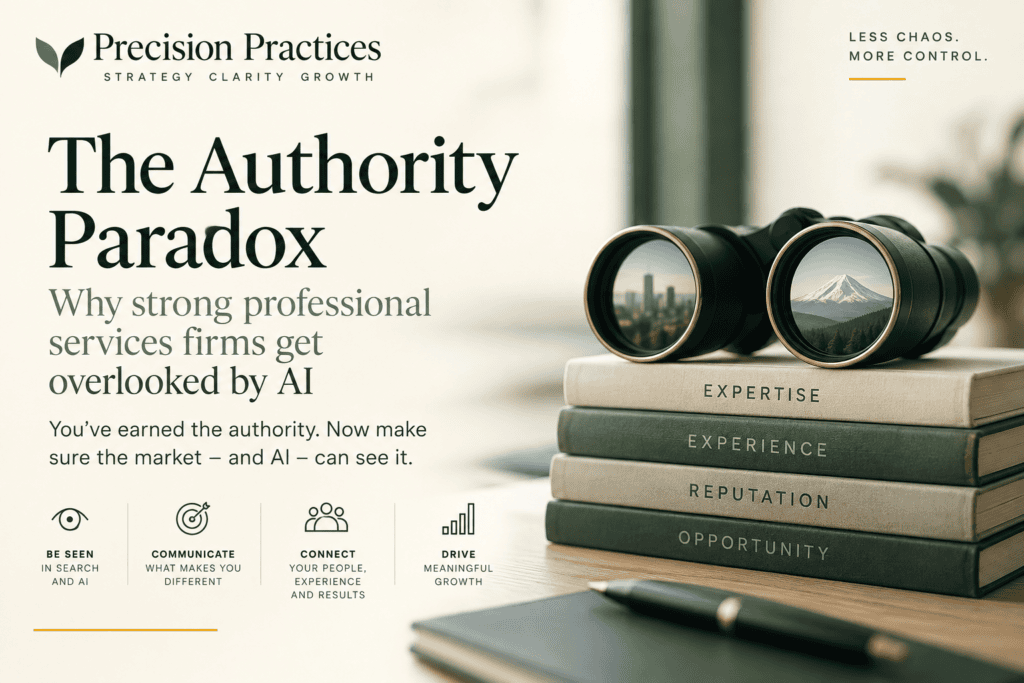
That is what we call the Authority Paradox.
Those fundamentals have not changed. What has changed is whether that authority is visible and understandable to the systems increasingly helping prospective clients decide whom to consider.
At Precision Practices, we see a growing disconnect between real-world authority and digital authority. A firm may be highly respected, have exceptional professionals and possess decades of relevant experience, yet still be poorly represented when Google, AI Overviews, ChatGPT, Gemini, Perplexity or another discovery platform tries to determine who has expertise in a particular area.
That is the Authority Paradox.
A firm can have significant authority and still make that authority surprisingly difficult to find, understand and verify.
What Does Professional Services AI Visibility Have to Do With Authority?
Professional services AI visibility depends on whether search engines and AI systems can understand the relationship between a firm’s expertise, people, services, results, thought leadership and external validation. A firm can possess considerable real-world authority while remaining difficult for AI to interpret if those signals are fragmented or poorly connected.
The problem is rarely that the expertise does not exist. More often, the evidence is fragmented across attorney or professional biographies, service pages, articles, client results, reviews, awards, press mentions and third-party profiles without clearly showing how those elements relate to one another.
A prospective client who already knows the firm may connect those dots. Search engines and AI systems should not be expected to make the same assumptions.
This is becoming particularly important for law firms, consulting firms, accounting practices, financial advisory businesses and other knowledge-based professional services organizations. In these businesses, expertise is not simply part of the product. Expertise is the product.
AI Visibility for Professional Services Firms Is Really an Authority Problem
Much of the discussion around AI visibility focuses on optimization tactics. Firms are being told to add schema, publish FAQs, create more content, use particular keywords or restructure pages for generative search.
Those things can matter, but they are not the starting point.
AI visibility for professional services firms begins with making expertise understandable. A firm must clearly communicate what it does, who has the expertise, where that expertise applies, what evidence supports the claim and why an independent buyer should believe it.
Consider a law firm that describes itself as highly experienced in a particular practice area. That assertion becomes considerably stronger when the practice area connects naturally to attorneys with relevant experience, representative matters, case outcomes, jurisdictions, published insights, awards and external recognition.
The same applies outside legal services. A consulting firm that claims expertise in business transformation is more credible when its leadership experience, client outcomes, methodologies, case studies and thought leadership reinforce the same area of authority.
The issue is not simply whether the information exists somewhere on the website. The issue is whether the relationships between those pieces of information are clear.
Buyers Increasingly Start With the Problem, Not the Firm
Traditional professional services marketing assumed that prospective clients would eventually reach the firm’s website. A referral, Google search, advertisement or professional relationship would lead them there, and the website would help establish credibility.
That journey is changing.
A business owner facing a complicated transaction can describe the circumstances to an AI platform and ask what type of advisor is needed. A general counsel can ask which firms have particular experience in a specific jurisdiction. A founder whose company has stalled can describe the symptoms and ask what kind of strategic advisor might help.
The buyer does not have to start with a firm name.
That distinction matters because the discovery system must first decide which organizations belong in the conversation.
Google’s AI experiences and generative AI platforms increasingly synthesize information rather than simply returning a conventional list of webpages. That puts greater importance on whether a business has created enough clear, connected and credible evidence for its expertise to be interpreted correctly.
The question is therefore becoming larger than, “Can people find our website?”
The more important question is, “Can search engines and AI systems understand why our firm should be considered?”
Real Authority Can Be Hiding in Plain Sight
One of the recurring findings in Precision Practices audits is that professional services firms frequently possess far more authority than their websites communicate.
An experienced partner may have spent twenty years working in a specialized field, but the firm’s primary service page barely references that experience. A significant matter may appear on a results page without connecting the outcome to the professionals responsible for it. An award may be listed in a biography without explaining the area of expertise it validates.
Strong client reviews can describe exactly what differentiates the firm while the homepage relies on broad phrases such as “trusted advisor,” “personalized service” or “innovative solutions.” Thought leadership can demonstrate deep knowledge but remain disconnected from the service area and people whose authority it should strengthen.
None of these problems requires the business to manufacture credibility.
The credibility already exists.
The work is to expose it, structure it and connect it.
Why More Content Is Not Automatically the Answer
Professional services firms have been encouraged to publish for years. Many now have substantial libraries of articles, service pages, newsletters, biographies, announcements, podcasts and other content.
More does not necessarily mean clearer.
In fact, content volume can sometimes make the authority problem worse. Older pages compete with newer pages, several pieces address essentially the same topic, important evidence is buried beneath generic material, and the firm’s strongest expertise becomes diluted across hundreds or thousands of URLs.
A firm can therefore possess a large digital footprint while providing a surprisingly weak answer to a simple question: What is this organization genuinely known for?
That question should influence content strategy far more than publishing frequency.
Before creating the next ten articles, professional services firms should understand which expertise they want to own, which evidence supports that positioning and whether the existing digital ecosystem reinforces it.
Authority Needs an Architecture
At Precision Practices, we think about this as authority architecture.
Authority architecture is the deliberate connection between the firm, its professionals, its services, its experience, its results, its markets and the independent evidence supporting its credibility.
For a law firm, that relationship might look conceptually like this:
Firm → Attorney → Practice Area → Matter or Result → Jurisdiction → Supporting Insight → External Validation
For another professional services organization, the entities may differ, but the principle remains the same:
Firm → Expert → Capability → Client Problem → Evidence of Outcome → Thought Leadership → External Validation
The objective is not to build artificial pathways for a machine. The objective is to make the expertise of the business easier for everyone to understand.
Search engines benefit from that clarity. AI platforms benefit from that clarity. Most importantly, prospective clients benefit from that clarity.
Reputation Still Matters, but Reputation Now Needs to Travel Digitally
None of this diminishes the importance of reputation.
Professional services remain relationship businesses. Referrals, trust, prior experience and professional networks continue to influence major buying decisions, particularly when the stakes are high.
But a referral is increasingly followed by independent validation.
Someone recommends the firm. The prospective client searches the name, reads about the professionals, checks reviews, explores relevant experience, looks at LinkedIn, scans recent thinking and may now ask an AI platform what it knows about the organization.
The referral may open the door, but it no longer controls everything that happens next.
This creates an interesting challenge for highly established firms. Businesses that have historically relied on reputation may actually have less developed digital authority because they have never needed to explain themselves as aggressively as newer competitors.
Their clients already knew what made them good.
AI does not.
The Best Firm Does Not Automatically Become the Most Visible Firm
This is the uncomfortable part of the shift.
Search engines and AI systems do not have direct access to the experience sitting inside the heads of partners, consultants, accountants, advisors or other professionals. They work from observable evidence.
That does not mean the business with the best optimization will inevitably defeat the business with the best expertise. It does mean that genuine authority that is poorly communicated can be undervalued.
The strongest firms should not respond by becoming louder.
They should become more explicit.
If a professional has exceptional expertise, show where it applies. If the firm has meaningful results, connect those outcomes to the relevant services and professionals. If outside organizations consistently recognize the firm’s work, use that validation to reinforce the areas in which the business wants to be understood as authoritative.
The objective is not to tell AI that the firm is exceptional.
The objective is to create enough credible evidence that the conclusion can be reached independently.
This Is Bigger Than SEO
SEO remains important. A technically sound website, logical information architecture, relevant content, internal linking and strong search fundamentals still matter enormously.
But this is not simply an SEO problem.
It is a positioning problem.
A firm cannot create a strong authority architecture without answering some fundamental business questions. What do we want to be known for? Where are we genuinely differentiated? Which professionals carry that expertise? What proof do we have? Which clients or matters demonstrate it? Where do we have external validation rather than self-description?
Those questions sit at the intersection of brand, growth strategy, client experience, content, SEO and AI visibility.
That is precisely why treating AI visibility as an isolated marketing tactic misses the opportunity.
The exercise can expose something much more valuable: whether the market sees the same business the leadership team believes it has built.
How Can a Professional Services Firm Improve Its AI Visibility?
Improving AI visibility begins by identifying the areas where the firm has genuine authority and then making the supporting evidence easier to understand.
That means aligning service and practice-area pages with the professionals who deliver the work, connecting expertise to representative results or case studies, strengthening internal links between related evidence, publishing substantive insights around priority areas and incorporating appropriate external validation.
Technical elements matter as well. Clear page structure, descriptive headings, useful metadata, schema markup, strong entity relationships and disciplined internal linking can help search engines and AI systems interpret the information more accurately.
But technical optimization should reinforce the business story rather than substitute for it.
If the underlying positioning is unclear, no amount of markup will solve the more important problem.
What Does AI Authority Look Like for a Professional Services Firm?
Strong AI authority does not mean appearing in every AI-generated answer.
It means that when a question genuinely matches the firm’s expertise, the digital evidence gives search engines and AI systems a defensible reason to recognize the organization as relevant.
That evidence should be consistent across the firm’s website and, where possible, reinforced by independent sources. The firm’s own claims, professional biographies, results, thought leadership, reviews, media coverage, awards and other credibility signals should tell a coherent story rather than several disconnected ones.
The firms that do this well will not simply become easier for AI to understand.
They will also become easier for people to choose.
Before Creating More Content, Connect the Authority You Already Have
Professional services firms do not usually suffer from a complete absence of expertise. Many suffer from an inability to translate decades of expertise into a digital structure that reflects the true strength of the organization.
That is why our starting question at Precision Practices is rarely, “What else can we publish?”
We are much more interested in asking, “What authority has already been earned, and are we making it possible for the market to understand it?”
The answer can expose significant gaps. It can also uncover a considerable competitive advantage.
A firm may not need another hundred pages of content.
It may need the right fifty pages to work considerably harder together.
That is the real implication of the Authority Paradox. The firms that succeed in the next era of professional services discovery will still need exceptional people, strong results and genuine expertise, but they will also need to make the relationships between those things unmistakably clear.
Authority still has to be earned.
Increasingly, it also has to be understood.