
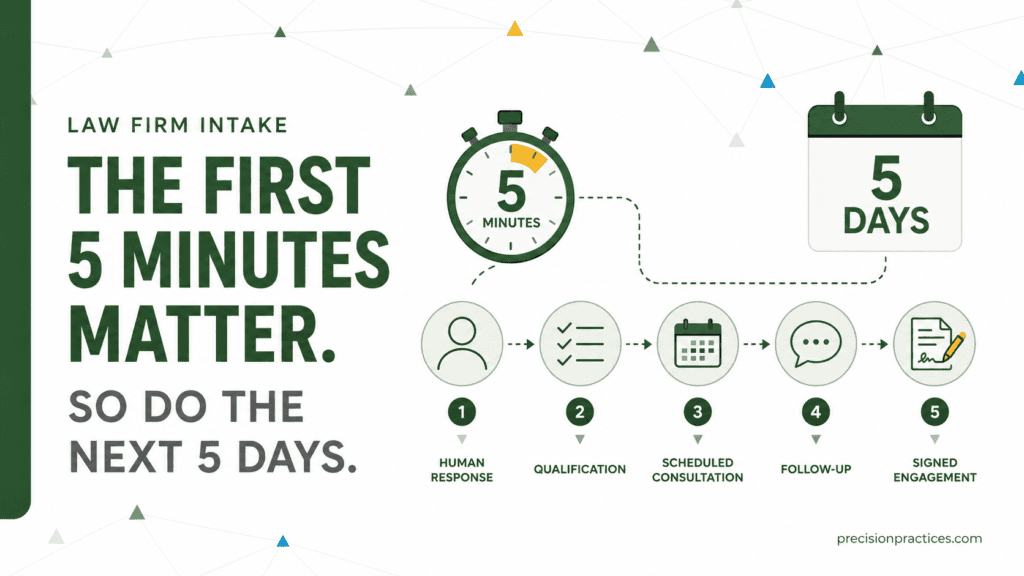
Law firm intake is often reduced to one number: speed to lead. Respond quickly and the prospective client is yours. Respond slowly and another firm will get there first.
I understand why that message took hold. When someone is injured, facing criminal charges, contemplating divorce or dealing with the loss of a job, they are not filling out a contact form because they want to hear from a lawyer next week. They need to know that someone has received the message and understands that the situation matters.
But I have also seen firms respond quickly and still lose a perfectly viable matter. The initial call was returned, so the lead was marked as contacted. What happened next was much less clear. The prospective client repeated the same information to several people, waited for someone to decide whether the matter was worth an attorney’s time, or agreed to a consultation without ever receiving a useful confirmation. Sometimes the firm sent an engagement agreement and assumed the job was done.
It was not.
The first five minutes matter because they establish responsiveness. The next five days matter because they reveal whether the firm has a law firm intake process that can turn that early confidence into a retained client.
What makes a law firm intake process effective?
An effective law firm intake process moves a prospective client from inquiry to engagement without unnecessary delay, repetition or uncertainty. It combines a fast personal response with clear ownership, appropriate qualification, prompt conflict review and case evaluation, a scheduled next step, consistent follow-up and a straightforward engagement process. The real measure is not how quickly the firm touched the lead. It is how reliably qualified inquiries become retained matters.
In this article
- Why response time is only the first part of law firm intake
- Where qualified prospects lose confidence after the first call
- What should happen during the next five days
- Which law firm intake metrics leadership should review
- How a better intake process improves conversion without buying more leads
Speed matters, but it is not the finish line
The legal industry has improved its response time. Hennessey Digital’s 2025 Lead Form Response Time Study found that 25% of the law firms studied responded to an online inquiry in under five minutes, up from 13% in 2021. The median response time was 13 minutes.
There is also a much less flattering number in that research: 26% of firms did not respond to an online lead within seven days. That is an obvious failure. A firm cannot convert an inquiry it never answers.
The more interesting problem sits between those two extremes. It is the firm that responds promptly, records the activity and believes its law firm intake is working, even though qualified prospects continue to disappear before signing.
A fast response earns attention. It does not automatically create confidence, demonstrate judgment or make the next step easy. Those things happen through the rest of the intake experience.
Answering is not the same as moving the matter forward
Most prospective clients do not understand a law firm’s internal structure. They do not know which information the intake team needs, who evaluates a potential matter, how long a conflict check should take or when an attorney becomes involved. They only know whether the firm appears to be helping them move toward an answer.
That distinction matters. An intake specialist can return a call in three minutes and still leave the person wondering what happens next. An automated email can arrive instantly and provide no more reassurance than the original website form. A consultation can be offered but not placed on the calendar.
The activity happened. The progress did not.
When we examine law firm intake, one of the first questions we ask is whether every interaction creates a clear next step. If the prospective client is left waiting for an unnamed person to call, searching for a document nobody explained, or wondering whether the firm is interested, the process has stalled even if the response-time report looks excellent.
Where law firm intake breaks after the first response
Qualification begins to feel like an interrogation
Firms need enough information to determine fit, urgency, conflicts and potential value. That does not mean the first conversation should feel like a deposition conducted by someone reading from a script.
The questions should make sense to the person being asked. The intake specialist should be able to explain why particular information matters and recognize when a frightened, injured or overwhelmed caller needs a moment before being pushed to the next field in the system.
Good qualification protects the firm’s time without making the prospective client feel processed. It gathers what is material, identifies what is still missing and tells the person what will happen with the information.
The consultation is discussed but not secured
“An attorney will get back to you” is not a next step. It is a holding pattern.
Whenever possible, the consultation should be scheduled while the firm has the prospective client’s attention. The confirmation should state when the conversation will occur, who will participate, how it will take place, and what the person should prepare. If scheduling requires attorney review first, the prospective client should know when to expect a decision and who owns that follow-up.
Clio’s current Legal Trends Report identifies automated consultation booking, confirmations, follow-ups and reminders among the time-saving systems used by growing firms. Automation is valuable here because it protects consistency. It should support the human experience, not replace it.
Ownership becomes invisible
This is one of the most common law firm intake failures, particularly when several people touch the inquiry. The receptionist assumes intake owns it. Intake is waiting for an attorney. The attorney believes someone has requested the missing information. Everyone is involved, but nobody is clearly responsible for moving the matter forward.
Every qualified inquiry needs a named owner and a defined deadline for the next action. That ownership can change as the matter progresses, but it should never disappear between stages.
From the prospective client’s perspective, internal handoffs should feel coordinated. Repeating the same story, forwarding unanswered emails, and trying to discover who is making the decision all reduce confidence at precisely the moment the firm is asking to be trusted.
Follow-up stops after one or two attempts
People do not always answer an unfamiliar number. They miss voicemails, overlook emails and delay decisions because the legal problem itself is stressful. A missed response does not necessarily mean the person has hired another firm or lost interest.
Yet many intake processes rely on individual memory. Someone intends to call again, gets pulled into another matter and never does. The lead remains open until it is eventually marked lost, often without a meaningful reason.
A credible follow-up sequence uses more than one appropriate channel, spaces contact attempts sensibly and makes every message useful. “Just checking in” does very little. A better message confirms what the firm still needs, explains the next step and gives the person a simple way to respond.
The engagement agreement becomes another obstacle
Firms sometimes treat the signed agreement as separate from law firm intake, as though intake ends when the lawyer says yes. The prospective client experiences no such distinction. Until the agreement is understood, completed and returned, the matter is not retained.
The firm should know when the agreement was sent, whether it was opened, what questions remain, and who follows up. Electronic signatures help, but technology cannot fix confusing language, unexplained fees or silence after the document arrives.
The goal is not to pressure someone into signing. It is to remove avoidable uncertainty from a decision the firm has already agreed it wants the person to make.
What should happen during the next five days?
Five days is not permission to move slowly. Some practice areas require decisions in hours, not days. The point is that law firm intake needs a defined path beyond the initial response, including when the prospective client is not ready or able to complete everything immediately.
Day zero: Respond, understand and create the next step
The firm should acknowledge the inquiry personally, collect the essential information, assess urgency, and establish ownership. Before the conversation ends, the prospective client should know what happens next and when.
If the matter appears qualified, schedule the consultation or provide a specific timeframe for review. Send a useful confirmation while the conversation is still fresh.
Day one: Confirm that momentum has not been lost
Make sure required information was received, the appointment is on the calendar, and the prospective client knows how to participate. If the firm promised an answer after attorney review, deliver it or communicate the reason for the delay.
This is also the point to resolve simple friction. A broken scheduling link, missing form, or unanswered question should not be allowed to cost the firm a strong matter.
Days two and three: Follow up with a purpose
If the person has not responded, use an appropriate second channel and make the requested action clear. If a consultation occurred but no decision was made, address the questions that remain rather than sending a generic reminder.
The intake record should show what happened, what is pending, and who is responsible. No qualified inquiry should depend on someone remembering a conversation from two days earlier.
Days four and five: Create clarity, even if the answer is no
By this stage, the firm should know whether the prospective client is moving forward, still deciding, unresponsive, or not a fit. That does not mean every lead should be closed on the fifth day. It means the status and next action should be deliberate.
If the firm cannot help, say so promptly and respectfully. If the person needs more time, agree on the next contact. If the firm wants the matter, do not let an unsigned agreement sit untouched while everyone assumes someone else is following up.
What law firm intake metrics should leadership review?
Response time belongs on the dashboard, but it should not dominate it. A law firm can improve its average response time without improving revenue if the rest of the process remains inconsistent.
At a minimum, leadership should be able to see:
- Time to first meaningful contact, not simply an automated acknowledgment
- Percentage of inquiries successfully contacted
- Percentage of inquiries that meet the firm’s qualification criteria
- Qualified inquiry-to-consultation booking rate
- Scheduled consultation attendance rate
- Consultation-to-signed-client conversion rate
- Time from inquiry to signed engagement
- Follow-up attempts and channels used
- Conversion by referral source and marketing source
- Specific reasons qualified prospects did not retain the firm
The last measure is frequently the most revealing. “Lost” is not a reason. Neither is “went elsewhere.” Leadership needs to know whether the prospect could not reach the firm, disliked the experience, did not understand the terms, selected a faster competitor, was never followed up with or was not actually a fit.
One intake result that changed the economics
In one law firm intake review, qualified inquiries were reaching the firm, but fewer than 15% became clients. The immediate temptation would have been to generate more leads. That would simply have poured more opportunity into the same broken process.
The firm addressed slow response, inconsistent follow-up and unclear ownership. Within 90 days, conversion reached 31%. Time to first contact fell below six hours, and the cost per signed client dropped 28%.
Not every firm will produce the same result, and anyone promising that it will is selling confidence they do not own. The lesson is more practical. The firm did not need to double its marketing budget to double the conversion rate. It needed to take responsibility for what happened after the inquiry arrived.
Before buying more leads, follow one existing lead
If a firm wants to understand whether its law firm intake process is working, I would not begin with the dashboard. I would select a small group of recent qualified inquiries and follow each one from the first call or form submission through the final outcome.
Who responded? What did the prospective client hear? What was the next step? Was it scheduled? Who owned it? How many times did the firm follow up? How easy was it to sign? If the person did not retain the firm, does anyone know why?
That exercise usually reveals more than another report on lead volume. It shows where the firm’s promise is being tested and where confidence is quietly being lost.
The first five minutes still matter. But if the next five days are improvised, the firm has not solved intake. It has simply become faster at starting a process it does not consistently finish.
To examine where your firm may be losing qualified opportunities, review the Precision Practices Law Firm Intake Diagnostic or explore how intake fits into the broader law firm growth system.
Law firm intake FAQ
What is law firm intake?
Law firm intake is the process of receiving, evaluating and converting a prospective client’s inquiry into a retained matter. It begins with the first phone call, form submission, chat or referral and continues through qualification, conflict review, consultation, follow-up and the signed engagement agreement.
How quickly should a law firm respond to a new inquiry?
A law firm should respond as quickly as it can provide a useful, human next step. Immediate acknowledgment is valuable, but it should be followed promptly by meaningful contact from someone who can understand the inquiry, assess urgency and move the prospective client forward.
Why do law firms lose qualified leads after responding?
Qualified leads are often lost because ownership is unclear, qualification feels impersonal, consultations are not firmly scheduled, follow-up is inconsistent or the engagement process creates unnecessary friction. A fast first response cannot compensate for uncertainty during the rest of the intake process.
What is the most important law firm intake metric?
No single metric explains intake performance. Response time matters, but qualified inquiry-to-signed-client conversion is more commercially meaningful because it measures whether the complete process produces retained matters. Firms should also track contact, consultation, attendance, follow-up and reasons for loss.
Can automation improve law firm intake?
Yes. Automation can support immediate acknowledgments, scheduling, reminders, document collection, follow-up and reporting. It works best when it protects consistency and makes the experience easier. It should not replace human judgment, empathy or clear ownership.
About the author
Genie Lutz is co-founder of Precision Practices and a former PwC partner with more than 30 years of experience helping law firms and professional services businesses strengthen positioning, growth strategy, revenue operations and client acquisition. Her recent work includes nearly 300 website and AI visibility reviews examining how clearly firms are understood by prospective clients, search engines and AI platforms.