What is a Clarity Audit Designed to Find?
A firm can be highly capable and still be difficult to understand.
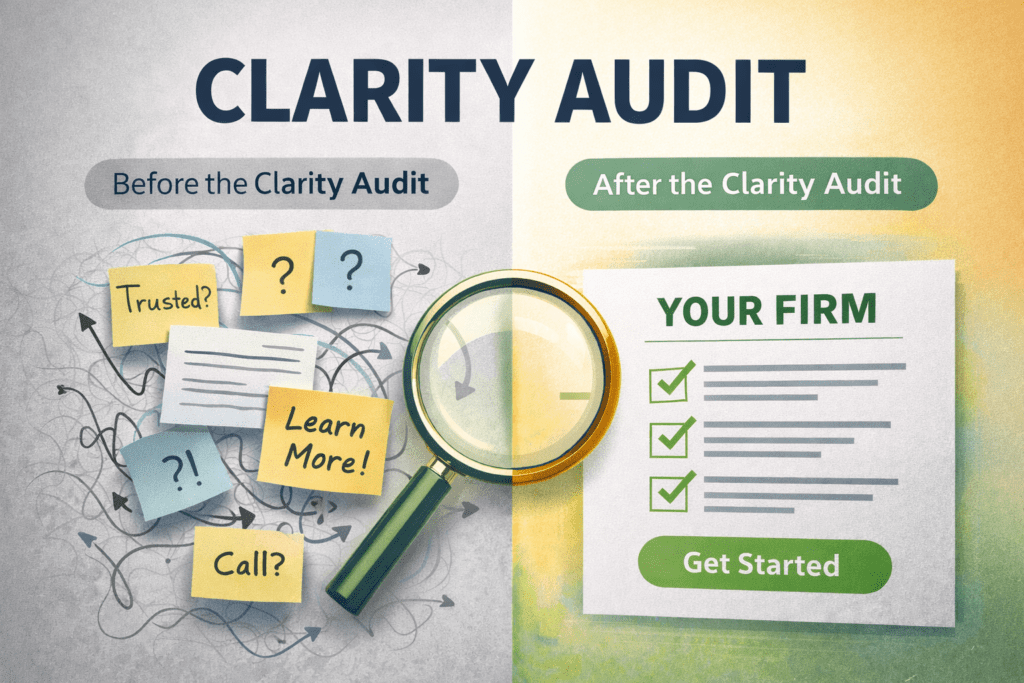
A clarity audit reveals why a strong firm may still be overlooked by identifying where its positioning, messaging, and digital presence make it difficult for prospective clients to understand its value.
Its website may describe several services without clearly explaining which problems it solves. Its partners may introduce the firm differently. Its marketing may produce attention without generating qualified conversations. Prospects may recognize the firm’s experience but struggle to understand why they should choose it over a credible alternative.
These are not necessarily lead-generation problems. They are often clarity problems.
A clarity audit evaluates whether your positioning, messaging, services, marketing and sales process communicate a coherent reason to choose your firm. It identifies where uncertainty is weakening differentiation, reducing conversion and making growth too dependent on the founder or a small number of rainmakers.
What is a clarity audit?
A clarity audit is a structured review of how a firm presents its value to the market and moves prospective clients from initial awareness to a confident decision.
It examines whether the firm can answer five essential questions:
Who is the firm best equipped to serve?
Which important problems does it solve?
What makes its approach meaningfully different?
What evidence supports its claims?
What should an interested prospect do next?
Precision Practices’ Clarity Audit examines these questions across the firm’s website, service architecture, marketing materials, thought leadership and business-development process.
The purpose is not to invent clever language. It is to make the firm easier to understand, trust and select.
Who benefits from a clarity audit?
Clarity audits are particularly useful for law firms, founder-led businesses and professional services organizations that have grown through reputation, referrals or individual relationships.
The firm may already have strong expertise and satisfied clients. The problem is that its expertise has not been translated into a consistent market position.
A clarity audit is worth considering when:
Your firm offers several services but lacks a clear organizing proposition.
Partners describe the firm differently.
Prospects frequently ask what makes you different.
Website traffic produces few qualified inquiries.
Marketing generates activity without measurable commercial progress.
Referrals remain the primary source of new business.
The founder or a senior partner must participate in nearly every sale.
The firm has outgrown the positioning that helped it reach its current stage.
A new website, advertising campaign or content calendar will not correct these underlying issues by itself. Increasing promotion can simply distribute an unclear message to a larger audience.
What does a clarity audit evaluate?
1. Audience clarity
The audit determines whether the firm has clearly defined the clients it is best positioned to serve.
Broad claims such as “we work with businesses of all sizes” may sound inclusive, but they rarely help the right client recognize a strong fit. Effective positioning identifies the situations, problems and decision-makers for whom the firm is especially relevant.
Audience clarity does not require refusing every opportunity outside a narrow category. It requires establishing a recognizable center of gravity.
2. Problem and outcome clarity
Prospects rarely begin by searching for a provider’s preferred list of services. They begin with a problem, risk, missed opportunity or desired outcome.
A clarity audit evaluates whether the firm’s message starts with the client’s situation or with an internal description of capabilities.
Compare these two approaches:
“We provide strategic marketing and business-development services.”
“We help professional services firms turn referral-dependent growth into a more visible and repeatable business-development system.”
The second statement gives the prospect a problem and an outcome it can recognize.
3. Differentiation and positioning
Many firms rely on claims such as experienced, responsive, strategic, client-focused and results-oriented. These qualities may be valuable, but they are also claimed by nearly every credible competitor.
Real differentiation is usually found in the combination of:
The clients the firm understands best.
The problems it is designed to solve.
Its point of view about those problems.
Its method or operating model.
The evidence that demonstrates its effectiveness.
Strong brand positioning gives the market a specific reason to remember the firm and a defensible reason to choose it.
The goal is not to sound radically different for its own sake. It is to make the firm’s most relevant differences visible and meaningful.
4. Offer and service clarity
Service pages often describe what a firm can do without explaining when a client needs the service, how the engagement works or what changes as a result.
A clarity audit reviews whether each offer has:
A defined audience.
A recognizable trigger or problem.
A clear scope.
A credible process.
A practical outcome.
Evidence supporting the promise.
An appropriate next step.
This is especially important when a firm has accumulated services over time. Without a coherent structure, prospects may struggle to determine where to begin.
5. Conversion and sales clarity
A firm’s message must survive beyond the homepage.
The audit examines whether the same positioning appears consistently across:
Website pages.
Proposals and pitch materials.
LinkedIn profiles and company content.
Articles and newsletters.
Discovery calls.
Partner introductions.
Referral-partner conversations.
Follow-up communications.
If the website makes one promise, the proposal emphasizes another and every partner tells a different story, the prospect must assemble the firm’s value independently.
That friction slows decisions and makes sales unnecessarily dependent on personal explanation.
Five warning signs that your firm may have a clarity problem
1. Your messaging changes depending on who is speaking
Some variation is natural, but prospects should hear the same essential explanation of whom the firm serves, what it solves and why its approach matters.
If every partner describes the firm differently, the market cannot form a stable impression.
2. Your differentiation depends on generic claims
Experience and responsiveness are important, but they rarely create a distinctive position by themselves.
If a competitor could replace your firm’s name with its own without changing the meaning of your website, your positioning is probably too generic.
3. Your website receives attention but produces few qualified conversations
Poor conversion is not always a traffic problem.
Visitors may be leaving because they cannot quickly determine whether the firm understands their situation, offers the right solution or has earned enough trust for a next step.
4. Your marketing produces content without building authority
Publishing frequently does not automatically create a market position.
Effective thought leadership should clarify an important problem, offer a useful point of view and demonstrate the firm’s expertise. LinkedIn’s B2B thought-leadership research reports that decision-makers particularly value research and data, better explanations of business problems, and concrete guidance or case studies.
Content should reinforce the same strategic position over time rather than introduce a different message every week.
5. Selling still depends heavily on the founder or senior rainmaker
Founder-dependent selling often indicates that the strongest explanation of the firm exists only in one person’s head.
The founder understands which examples to use, how to interpret the prospect’s problem and how to connect the firm’s capabilities to a commercial outcome. Other people may know the services but lack the same narrative.
A clarity audit helps convert that individual knowledge into a repeatable message and business-development system.
What should a clarity audit produce?
A useful audit should not end with a list of vague observations. It should produce prioritized decisions and practical recommendations.
Typical outputs include:
A concise positioning statement.
Clearly defined priority audiences.
A hierarchy of client problems and desired outcomes.
A differentiated value proposition.
A better-organized service architecture.
Core proof points and evidence gaps.
Website and conversion recommendations.
Messaging guidance for partners and business-development teams.
A prioritized implementation roadmap.
The objective is to establish a common strategic foundation for the firm’s website, content, outreach and sales conversations.
What happens after the audit?
An audit identifies what is unclear. The next stage is implementation.
That may include revising the website, reorganizing service pages, documenting case studies, improving proposals, creating thought-leadership themes and building a more consistent business-development process.
The findings should inform the firm’s broader strategic growth priorities so that marketing activity, commercial goals and operational capacity support the same direction.
Clarity must come before scale. Otherwise, the firm risks spending more money to promote a message the market still does not understand.
Does your firm need a clarity audit?
Your firm may need one if its expertise is stronger than its market position, its services are difficult to explain, its website produces weak conversion or growth still depends heavily on a founder or senior rainmaker.
The central question is simple:
Can the right prospect quickly understand why your firm is relevant, credible and meaningfully different?
If the answer varies by page, partner or sales conversation, the problem is probably not a lack of capability. It is a lack of clarity.
A clarity audit creates the foundation for correcting that problem before the firm invests further in content, advertising, technology or business-development activity.